So I posted the review of my video of Future Shock on google plus, but I forgot to create a blog about it. For some reasons I am having trouble uploading the link on to the blog so here is a link.
The video review of Future Shock I was pretty hard for me, I"m not going to lie. After about twelve takes I reached a point where I realized that because this is my first video, it won't be perfect. For some reason I just felt super self conciouse filming myself, I guess because it was because I was using a new medium.
For being my first video review I think I did a pretty good job, though my ideas could be a little more clearer. I don't think I explained the pain points of the book very well, and if I could do this assinment again, I think that I would write out exactly what I was trying to say as well as the main point that I would want to explain.
Overal, I think that this was an good expereince and excellent assinment to have in this class. I think that most people, including myself, have yet to make a book revie online so for me this was an excellent learning experience.
Showing posts with label Future Shock. Show all posts
Showing posts with label Future Shock. Show all posts
Friday, November 8, 2013

Monday, November 4, 2013
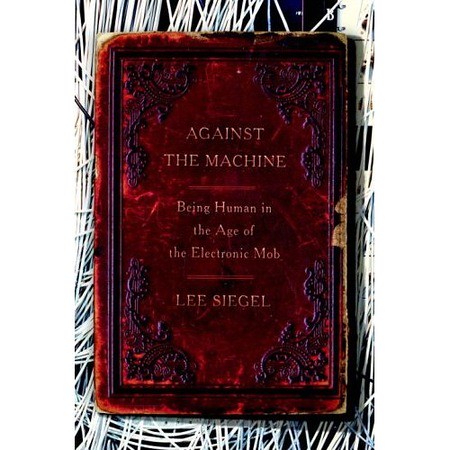
Siegel's Against the Machine: Review
Here is the link to the Goodreads review: https://www.goodreads.com/review/show/742375803
Despite its promising title, Lee Siegel's Against the Machine is less about the struggle to maintain our humanity in the digital age and more about his problem with how the internet age has completely bereft our society of creativity, impartiality, and pure artistic originality.
My very negative preview of Against the Machine was for the most part confirmed by my reading it. It is for the most part poorly written, with a few coherent statements and positive suggestions scattered amongst lengthy commentary on how the internet and its promoters have destroyed our culture and anecdotes about how the internet has turned its consumers or "prosumers" into distorted reflections of itself. He is all about how the internet is people with no talent or originality selling their poor interpretations of things they did not create. Value in this digital society is determined by popularity, not quality or artistry, and value is also based on marketability rather than detached enjoyment. Siegel refers a lot to Alvin Toffler's Future Shock (review by my friend Melee here), making references to how we have become more or less the very society that Toffler predicted. Between the lines of Siegel's ranting is a drawn-out elegy of the death of gatekeeping, regulated print culture, major media outlets and "real" art.
Ironically, although he complains about the bias of our individual-based internet culture, this book is distorted with his own biases, which was disappointing since I chose to read this book based because I thought it promised objectivity. Perhaps in writing this Siegel is presenting his book as an object lesson about how biased our individualized media is. If this is the case, Siegel is trying to imbue us with his own negative perception of humanity and modern culture. He has very little good to say about the internet or the people that use it. Understandably, Siegel wrote this book to reflect on his very negative experiences with the internet. So coming from a completely different perspective--where the internet can also be used as a source of good, uplifting content when created by good people for good reasons--Siegel perhaps would not blame me for thinking that he is missing half the picture.
What good points Siegel does make, as I have pointed out, are few and far between, but I will point them out just so we don't lose faith in the author's humanity. He does have a point that he says that the individualization/customization of the internet is not always a good thing. While it surrounds us with the things we like, however, individualized media insulate us from things we do not like. The internet encourages the glorification of the self and the self's fantasies rather than bringing us closer to understanding other people. Siegel claims that this contributes to the hate, bigotry, and misunderstanding on political blogs, comments, and other internet posts. People just say what they want rather than trying to understand the other person's point of view. I do sympathize with Siegel's claim that detachment from people and media as means to an end is disappearing, but I disagree that it is totally lost--or ever will be lost, from society.
What Siegel could have argued for better, if he argued at all, is a need for limited immersion in the internet culture. Instead, he just rants about the Internet as a corrupt media, an enhanced societal enslavement and a failed democracy, and a culture that has fallen for corporate capitalism's trap. He could have at least offered a solution to today's internet culture, if there is so much wrong with it--after all, in the prologue he says "Things really don't have to be the way they are." So how can they be, Mr. Siegel? Really?
I read this book on Kindle for PC. Against the Machine is divided into three segments with three chapters each. It is fairly short, easy reading.
Despite its promising title, Lee Siegel's Against the Machine is less about the struggle to maintain our humanity in the digital age and more about his problem with how the internet age has completely bereft our society of creativity, impartiality, and pure artistic originality.
My very negative preview of Against the Machine was for the most part confirmed by my reading it. It is for the most part poorly written, with a few coherent statements and positive suggestions scattered amongst lengthy commentary on how the internet and its promoters have destroyed our culture and anecdotes about how the internet has turned its consumers or "prosumers" into distorted reflections of itself. He is all about how the internet is people with no talent or originality selling their poor interpretations of things they did not create. Value in this digital society is determined by popularity, not quality or artistry, and value is also based on marketability rather than detached enjoyment. Siegel refers a lot to Alvin Toffler's Future Shock (review by my friend Melee here), making references to how we have become more or less the very society that Toffler predicted. Between the lines of Siegel's ranting is a drawn-out elegy of the death of gatekeeping, regulated print culture, major media outlets and "real" art.
 |
| Adam Thierer, Flickr |
What good points Siegel does make, as I have pointed out, are few and far between, but I will point them out just so we don't lose faith in the author's humanity. He does have a point that he says that the individualization/customization of the internet is not always a good thing. While it surrounds us with the things we like, however, individualized media insulate us from things we do not like. The internet encourages the glorification of the self and the self's fantasies rather than bringing us closer to understanding other people. Siegel claims that this contributes to the hate, bigotry, and misunderstanding on political blogs, comments, and other internet posts. People just say what they want rather than trying to understand the other person's point of view. I do sympathize with Siegel's claim that detachment from people and media as means to an end is disappearing, but I disagree that it is totally lost--or ever will be lost, from society.
What Siegel could have argued for better, if he argued at all, is a need for limited immersion in the internet culture. Instead, he just rants about the Internet as a corrupt media, an enhanced societal enslavement and a failed democracy, and a culture that has fallen for corporate capitalism's trap. He could have at least offered a solution to today's internet culture, if there is so much wrong with it--after all, in the prologue he says "Things really don't have to be the way they are." So how can they be, Mr. Siegel? Really?
 | ||||
| occidentalobserver.net |
Alvin Tofler's: Future Shock

https://www.goodreads.com/review/show/757000290
Living in a society that is centered on
technology, I have always been interested in learning more about how this
technological age we live in effects us as individuals, families, and as a
society. Alvin Toffler within his book Future Shock address within this book
the change that is happening within our society as the pace is constantly being
sped up through technology. Toffler in his book goes on to explain the consequences
and the future shock that can occur while living in living in a fast pace society due to
technology. Though this book was written over 30 years ago, the concepts and
issues that Alvin Toffler addresses within his book Future Shock are still
applicable today.
Future Shock was an interesting read as Alvin
Toffler tackles complex issues and topics as he seeks to answer the question
posed in his book “How can we prevent mass future shock, selectively adjusting
the tempos of change” (395). One of the
issues he address within his book ,concerning the negative consequences of
living in such a fast paced world, is the effect this will have on the family
as a whole. Toffler examines how because
the pace within society gets faster and faster, the process when it comes to
growing up, leaving home, getting married, and starting a family will become in
a way so rushed that Toffler suggests that this process will become so rushed
that he says that marriage will become in a way non-existent.
Though the book was a slow read in the beginning,
Toffler manages to introduce various topics and aspects of the effect of living
in a continually increasingly fast paced society. I feel that though this was written some time
ago, today as a society we are still seeking answers to many of the questions
that are brought up within Future Shock.
Overall, I would recommend this book because it is an interesting read
and the concerns are still applicable today.
Saturday, November 2, 2013
Embracing The Increasingly Fast Pace and Changing World
The age of technology that we live in today allows us to constantly
and continually receive information at an alarmingly fast pace. Technology
allows people access to instantaneous
updates, everything from what their roommate is thinking about to being able to
keep track of current events provided by online newspapers. So how does this effect individuals as they
are constantly bombarded by an endless stream of information that is available
in the day and age that we live in?
Within Alvin Toffler book Future Shock that I am reading, he address the
issues surrounding the accelerated pace that comes with technology. One of the main issues he address within his
book is the divide between accepting and rejecting the fast past world that he
lived in. He observes in his book two reactions
towards the fast paced society in which people during the 70’s were living in.
The first group he describes are people who enjoy living in a fast paced
society while other individuals in response wish as he states to “get off the
merry-go-round” (37). Though the
American society in the 70’s was vastly different from society today, there
still exists today the concern of trying to have a happy medium between
embracing technology, while at the same time trying to not be consumed by it.

While exploring
Flickr more, it’s interesting to see how much information is shared and uploaded
on the photo sharing site. It is easy to
spend hours looking and browsing through photos and groups on any social sites ranging from Facebook to Instagram. So though we live
in a much faster pace today, the concerns and issues of how people
deal living in a fast paced world are still valid concerns today. Do you ever
feel overwhelmed at the amount of information that is obtainable in our
society? How do you find a balance between being connected and finding time to
disconnect?
Subscribe to:
Posts (Atom)