Showing posts with label fandoms. Show all posts

Wednesday, December 18, 2013

Digital Culture and Literary Studies

Moby-Dick as a Paragon of the Literary Side of Digital Culture.

The humanities are about the expressions of the tensions and realities of human life. In the digital age, literature introduces us to the key tensions of living in and making sense of a wired world. The challenges of the digital age are not different from those of previous generations except they are being applied to rapidly advancing technology. Moby-Dick is a worthy text for the mediation of digital and literary themes because of its commentary on the tensions of human life. 

The debate over the creation and classification of content is a major debate of the digital age. The digital age has introduced tools such as Diigo, Pinterest, and Storify for classifying and sorting out information, but the idea of categorizing as a means of understanding is nothing new. In his chapter on “Cetology” in Moby-Dick, Ishmael attempts to introduce readers to the variety of whales that live in the ocean and their place in the animal world. His use of literary terms such as “folio” and “quarto” for classifying whales by size brings up the question of how we classify literature in general (Melville 119). Moby-Dick in itself is an interesting text because it is difficult to label as either a novel or an encyclopedia or a memoir because it breaks or bends the rules of each of these genres in some ways. Classifying Moby-Dick is one thing, but classifying digital content can be another fish entirely. However, understanding how literature is classified offers good perspective for understanding the nature of the other: if you know what something is, you know what to do with it and how it works. If something is a combination of genres, you may identify it by its different components. 

Kaylee analyzed the travel industry in the digital age. Moby-Dick, Kaylee remarks, is Ishmael's travel narrative.   Another way Moby-Dick can be seen as a travel narrative for the journey of navigating an ocean of information on a search for a specific goal or experience. Just like in the tourism industry, Ishmael brings together lots of information to create a journey for the reader, evaluating best and worst sources and ideas to sell his experience. Kelsey focused on the role of metadata for her research project. Analyzing metadata works for making sense of massive amounts of information to find meanings and interpretations. This sort of information can be put to good use. Kayla Swan, who focused on online citizen journalism, saw Ishmael as the ultimate citizen reporter, faced with questions on the ethics of sharing the story of the Pequod and the responsibility to help readers understand the situation he observed. 

Another context for the study of literature in the digital age is in terms of the role of mythology. Mythology is nothing new, but today's modern myths of movie franchises and fandoms are perpetuated online through digital culture, and the popularity of the mass media is faced every day by individual students. Moby-Dick has its own mythology in popular and academic culture, but in addition to this it is a metaphor for the role of mythology: the White Whale is the ultimate myth, Ahab is the ultimate believer in this myth; and Ishmael questions a lot of what he sees on the ship and in the mythology of whaling. Every individual within a mythology interprets a myth's symbols and their functions differently, as Ahab's officers question the symbols of the dubloon (385-89). Furthermore, every individual defines mythology differently, and they use it and remix it at will: online content proliferates and remixes copyrighted material regardless of restrictions. As Ishmael observes of whales, and perhaps of humankind's ideas, one man's loose fish is another's fast fish (354). 

Finally, evaluating the tensions of literary and digital cultures requires entering the conversation online. The conversation is as old as time itself, but the medium is new and it is in a lot of different ways to a lot of different people, not just scholars. Studying digital culture in the context of literature allows students to see their ideas as a means to participation as well as an end to self-expression.

Embracing the Creative Mode of Literary Studies Through Remix

For the optimal study of literature in the digital age, I propose an approach based on remixing and remaking the content of original texts and analyzing such re-creations of studied texts. The purpose of this approach is to allow students to have broader perspectives of literary texts other than those discussed in a formal classroom or scholarly setting. One of the main difficulties of the age we live in is being able to identify different perspectives and negotiate them. Placing a text in a different format can allow for different understandings of the text than otherwise possible. The curriculum of a literary course can be broadened to include re-tellings and adaptations of original texts, including dramatized adaptations as well as children's literature, recreation in a new genre, and remixed online content. Recall that some of the first popular novels of the eighteenth century, including Pamela and Camilla, were written in epistolary form. Frankenstein's frame story is a series of letters of a sea captain to his sister in England, in which he encloses the main story. Some passages in classic literature, as in the the books of Psalms and Isaiah in the King James Bible or Ahab's monologues in Moby-Dick, can be rewritten as poetry, and rewriting prose passages as verse can isolate words, rhythms, and other aspects of the passage that allow for consideration of the text as poetry.

 In a course based on remixed content from classic literature, students will also be encouraged to find, create, and share online remixed content such as memes, blogs, videos, and pop songs or raps. These different media allow for different perspectives of the original texts and enhance their studies. Epistolary literature or dialouge can be rewritten as a series of tweets on Twitter or status updates on Facebook. A course based on the remixing of classic texts will emphasize both the creative and academic aspects of literary studies. Allowing students to create their own content gives them a sense of empowerment, allows them to share their perspective about the content in question, and gives them a personal bond with the course material. 

Traditional academic scholarship will neither be disregarded nor held up as the sole standard for literary understanding, but both approaches will be emphasized as a medium for finding meanings within texts. A course based on remixing classic literary texts is meant to allow students to think about literature in terms of its complexity and the relevance of its ideas in today's world.

Tuesday, December 3, 2013

Lizy's Project Proposal about S.H.I.E.L.D.

Title: (Currently) Marvel's "Agents of S.H.I.E.L.D." as an Emerging Fandom: A Study in Fan Culture.

Thesis: Marvel's new television series "Agents of SHIELD" will succeed based on how it is projected through online media by digital fan communities.  Digital fan communities help fans navigate their immersion in a fandom to find meanings within their entertainment through online discussion and remixed content.  Fandoms grow better when their fans share content with their friends.  Dr. Wickman suggested I look at the scholarship on immersion and see how it compares to what I am seeing in fan culture.

Relevance:  Marvel's "Agents of S.H.I.E.L.D. is only in its first season.  In terms of both its episodes and its relationship with the fans, it has been dynamic.  It is part of the larger Avengers and Marvel fandom and one of the show's main producers is cult favorite Joss Whedon.  If there was any time to examine a possible fandom in the act of forming, this is the moment.  There is a lot of potential for the show and a lot of tension in the fan community.

Format:  I am thinking a formal essay, except maybe with picture snapshots of twitter and facebook posts.  Maybe I could go multimedia--not for the formal paper but the final blog post or something.

Curation of Content:  I started snipping pictures of Facebook and Twitter posts over break.  It will keep up.  I am also accumulating reviews of the show and fandom articles on Zotero.

Curation of Secondary Sources: I have read/am reading books about the Star Trek and Dr. Who fandoms.  I also have a few scholarly articles which I have curated via Google Docs and Zotero (I got it for Dr. Burton's Shakespeare Class--it's awesome!)

Curation of Community: I am following SHIELD fan sites on Twitter, the Helicarrier podcast and Agent Coulson's Army, and they in return are following me.  I am being followed by PhantasticGeek on Twitter. I follow the official SHIELD sites on Twitter and Facebook and most of the show's actors on Twitter.

Social Proof:  I normally watch SHIELD with my roommates and one or two friends, so I can talk to them about it.  I also have a guy friend CJ in the medieval club who likes the show (I mean, a lot of clubbies like the show, but CJ especially).  And then I am in contact with Jason Hamilton who is an expert on fandoms in general.
People I don't know directly:  I exchanged emails with I also tweeted the author of a Buzzfeed article about the Marvel Cinematic Universe's big impact on Hollywood.

Venue:  
So I just found this huge blog page about scholarly blogs and journals devoted to fandom studies.  Here is the link if my classmates or other interested parties want it: http://fanstudies.wordpress.com/fan-studies-journals/

Of the ones listed above, I want to submit to Participations, which is a journal of audience reception studies. Their organization exists because (quote from website) "we recognise that these fields are not at present well-supported within the broad academic communities. There are few undergraduate courses and even fewer postgraduate courses which emphasise this work. Only a small number of research students work in this area, compared to other kinds of work on all the many forms of cultural and media expression. Yet we believe that the findings of audience and reception work are of crucial importance to all our fields – not least because claims about the audience are so frequently embedded within other kinds of work, and within public discourses about media and culture."  

So it sounds like mine is the kind of paper they are looking for.
I would also like to submit to Transformative Works and Cultures, since it deals more specifically with fandoms.
The real challenge I am setting for myself is The Journal of Science Fiction Film and Television, which is published by Liverpool University Press IN THE UK!!!!!!!  More likely than not, if I got accepted to a conference they put on I'd have to do a video conference, but hey, it would still be cool.  The guidelines say I have to use UK grammar and spelling and also use specific citations for TV shows and actors.  My response:

self-generated meme.
What I need to do next:

Go through the Dr. Who fandom book I read over the break and comb for quotes.
Create an orderly history of FB comments and twitter quotes (also block out names).
Listen to the Helicarrier podcast
Post link to this blog and "Tweethis" statement to social media sites.  Ask fans about their views of fandom and S.H.I.E.L.D.
Start writing out the paper
Curate fan art and memes specifically related to SHIELD.
FIND SCHOLARLY ARTICLES ABOUT:
humor
fandoms and immersion
FIND SCHOLARLY ARTICLES BY:
Henry Jenkins
Cheryl Harris
get fandom books renewed at library
Find more recent SHIELD reviews


Friday, November 22, 2013

Final Project: How it's Looking right Now. Feedback Welcome

A thesis is like a scientific equation.  You need certain elements to come together to create a certain product. I am not entirely sure what the final product is going to be.  But I am now going to take this opportunity to lay out my ingredients on the table to see what I have and will likely end up with. This is not my final thesis and venue, but just me thinking through my ideas.  Lots of feedback would be welcome.

I want to somehow respond to my ideas on immersion from the midterm.  A good secondary term for immersion is engagement.  Using the terms more or less interchangeably, I define an individual's engagement or immersion within a fandom as a relationship with a fandom with the end goal of promoting a change change of value within the fandom, either for oneself or for the fan community.  Open immersion adheres to the values of the fan community and compromises with them to create value.  Closed immersion is only interested in the individual's veiw of how a fandom/fans should exist or behave and seeks to tear them down.

I also want to return to the idea of memes.  A fandom is a meme or contagious idea, as are the social morays within them.  Cultures have their own distinctive symbols, such as the harpoon or the line to Moby Dick's whalers, or Captain America's shield in the Avengers films.  Like these more physical symbols, there are also internal ideas that spread and change within a culture, like a whaling captain's responsibility to his crew or, to use an Avengers example, "COULSON LIVES!" It can be as simple as a joke or a motto, or as complex as a value judgment about a certain topic delivered by a community or an individual.  I want to understand how memes spreading within a fan community are a manifestation of people working together to add meaning to a fandom and pass judgment on media.  Thus,the  people create the fandom and not just the entertainment industry. (hmm, nice ring to that). Memes are a product of fan immersion.

The 19th-century whaling industry depicted in Moby Dick is its own culture and, in a way, a fandom, at least the way Ishmael regards it and the way Ahab works within it.  The difference between Ishmael and Ahab, as I pointed out in my midterm, is that one is openly immersed and the other is closed.  "Where Ahab errs, it seems clear, is in sacrificing others to his egocentric interpretation of reality[....] Disvaluing speech with other men in his desire for a dialogue with speechless nature, Ahab inevitably experiences the isolation that  lack of communication and lack of community entail" (Barnett 148).  Ahab closes himself off from all other interpretations of the White Whale than his own--human, natural, and supernatural--and charts his course of revenge accordingly.  The closed fan only interprets his fandom his own way and only opens himself to people or media that value his fandom the way he does.  Likewise the media producers that ignore the needs and desires of consumers are unable to sell their product or ignore larger opportunities for profit.  From my reading of the Star Trek Fan Phenomena, what made the difference between Star Trek being a failed TV show and the vibrant fan community it is today were the fans who incessantly clamored the TV networks for a continuation of the show--and that in the days when the internet itself was still the stuff of science fiction.  The digital age has turned fandoms into a force to be reckoned with.

 An open fan, however, is a breeding ground for memes, or in other words values other people's ideas about the value of a fandom and adds them to his own.  Ishmael is symbolic of this type of fan.
  "Ishmael [...] is purged of his antisocial feelings by his commitment to Queequeg and then [...]to humanity in general.  Intellectually saved by repudiating the narrowed perspective of Ahab's quest, and then physically saved by the caring of others, he is returned to a society whose common totems [...] he now willingly embraces" (147).
To put it more simply, Ishmael's experience in whaling culture re-fits him for life in human society in general.  A fan finds meaning and values within their fandom that they apply to real life and not just their narrow-minded quest for satisfaction.  Solidarity with fellow fans produces real-life relationships.  Fandom does not exist just for the sake of the entertainment but for the sake of well-being, not just for the individual but for the community.

My guinea pig for this project will be Marvel's "Agents of S.H.I.E.L.D."  This is a brand new TV show that is linked to a fandom (ie Marvel's Avengers) that is currently enjoying enormous success, although the show itself is currently received with mixed reviews.  I will be examining the success or failure of SHIELD's introduction to fans as a new fandom of its own and within the context of the Avengers fandom, and compare this to fandom evolution in general.  I will also trace the fan responses to the show before it premiered, during the first few weeks, and also the last three or more weeks, between which periods there has been an interesting change in fans' reception to the series.  In other words, how are we seeing the SHIELD fandom being created and adding to the Marvel fan universe?

I am not sure where I would want to submit my paper as of right now, but I would like to submit it to some conference or journal dealing with media or entertainment studies or pop culture/fan culture studies.  I also want this research project to be of benefit to the people who are actually producing the show.  I admit, trying to give Joss Whedon a report about himself sounds like preaching to the choir--but I want to demonstrate my engagement with SHIELD by trying to produce something that could represent a unique form of feedback to the industry about how their product is working and why--in other words, to point out that we are perhaps experiencing a unique phenomenon in the history of fandom. Heck, if I wanted to I could present this at LTUE or a comic-con next year.

The results of this survey  (in other terms, after doing a lot of thinking):
fandoms (Marvel (SHIELD))+memes+fan immersion=a unique phenomenon
argument: The Marvel fandom has the power to make or break the show's success because (1) the Marvel films and characters have a lot of value to the fans, particularly Coulson, (2) the fans are working together to derive value from watching the show, (3) and at a certain threshold of involvement, they will either express common approval or disapproval of the show that will make or break it. 
Then, add something that people in the higher tiers of academia or the industry don't know: Tell you what, I'm going to sleep on that.  The fans create the fandom. Give them stuff to build with.  How about that?  I'll post my final thesis/venue/other main ideas tomorrow or Monday.  I have a headache.  And the hiccups. Bedtime. zzzzz.

Saturday, November 16, 2013

Moby-Dick and Fan Culture

What I have decided to focus on for this post is communication within fandoms, particularly criticism about the fandom itself. 

Moby-Dick is considered a unique novel because of the broken or one-sided communication performed by the characters. As with all types of communication, the aggregate of the communication within the novel leads to a certain conclusion.   "[The] atypical nature of most speaking in the novel encourages the negative view[...]that the world is a place where communication is suspect and perhaps impossible" (Barnett 140). Although throughout the book various speeches and conversations are made about the White Whale and Captain Ahab, "the multitude of verbal styles consciously represents the heterogenious collectivity of mankind" (141)  Likewise, indvidual fans think differently and have different ideas, but they all generally come to the same conclusions.  


 Can fandoms be compared to a product?  Technically they start out as a product or series of products, such as a book or movie.   As the item increases in popularity, authentic merchandise as well as fan-created materials begin to circulate.  As people invest themselves emotionally within a fandom, or begin to immerse themselves within it, they seek to know whether or not the immersion is worth their emotional energy based on the opinions of others.  Fans promote fandoms because they like their involvement and seek to express their liking and their identity within it.  This especially happens within social media, because it brings together a variety of people who are not necessarily geographically or socially connected, but sometimes people who share mutual ties of trust.  Interested fans also examine the opinions of other people they don't know to get a feel for what the quality of something is. 

A study by Buzzetto and Moore found "participants exhibiting prosumer behaviors through the use of social media as a means to share comments, perspectives, and opinions about goods and services. As such, mediated messages conveyed through SNS [social networking sites] are influencing purchase decisions with word of mouth messages paramountin consequence and ability to impel action" (Buzzetto-Moore 77.)  In Moby-Dick, Ishmael starts out as a prospective whaler who goes off information he gathers from Queequeg, Captain Peleg, and other people with experience in the industry.  Later, Ishmael becomes such a fan of whaling that he spends most of the book promoting and detailing its work.

Participating in a fandom sometimes requires spending money to attend movie screenings, buy books/DVDs/Blu-rays, or to buy paraphanelia to the materials to make it.  Individuals who want to spend money may be influenced by their peers in their decision whether or not a product is worth investing in.  To give a personal example, I am not a Whovian (follower of Dr. Who), but I want to be because I have seen Whovian-generated memes on Facebook promoted by friends who ARE Whovians, and since I trust their reputation (aka I know they're awesome) I am inclined to think positively of the fandom.  Fandoms can also require serious time commitments (e.g. making memes or costumes). This is also true of online missionary work of the LDS Church, but that's another story.
David Tennant as the 10th Doctor.  Photo Courtesy ABC Radio. 


Then fans make them into something their own. Fans recreate their fandoms on social media sites for bite-sized chunks.  On You Tube, for instance, "they come to consume pop culture like movies, television, and songs thesame way they enjoy cookies or chips – in conveniently packaged bite-size nuggetsmade to be munched easily with increased frequency and maximum speed (Miller,2007) [...] It can be considered a buffet of “snack” videos, highly meeting people’s needs for high-speed entertainment munching" (Shao11 ) It's called getting your daily dose of [Insert fandom name here]).  Consider this version of "Call Me Maybe."  All current episodes of Star Wars in one setting.  If that isn't a pick-me up I don't know what is.


For fans, creating content can fulfill personal needs.  "On Wikipedia, people can create new items or edit existing items with results that are immediate, obvious, and available to the world. Such contributing experience can help people believe that they have an impact on the group and that support their own self-image as an efficacious person (see Bandura, 1995; Kollock)" (14-15).  So when I make or share a meme, I do it because I have observed something insightful about a fandom and want others to know about it.  I want to be a part of the fan dialouge and enlighten others about how awesome something is.

Self-generated meme.  Picture courtesy of ABC.
Then fans evaluate media created by other fans and the industry.  Because the internet is so customized to the individual user, user customization and feedback is vital to sites as well as fandoms and the creators themselves.  "Customization provides individuals with an opportunity to express their interests, tastes, thoughts, and values. It also has the potential to generate positive attitudes and behaviors towards the sites (Carpenter, 2000; Graham, 2002; Kalyanaraman and Sundar, 2006)" (Shao 18).  And in this way, fans get feedback from each other about their common interests and ideas.

So how about Marvel's Agents of SHIELD?  How does social media inform us about this show?  Following the conversations on Facebook that the FB site for the show has posted,  I have noticed the generally negative trend of commentary on the show.   However, the fans who are defending the show usually have the following reasons:
  1. The show is just barely starting and it could take a season or two to get on its feet.
  2. The show is supposed to be about the AGENTS, so obviously people who are expecting a mini superhero movie every episode WILL be disappointed.
  3. The show has a very small budget, which accounts for the lack of certain elements the viewers could be wanting, like having an actual superhero cameo.  For instance, a Hulk cameo would never work because the show does not have the budget for that (and in my opinion, even if it was just Bruce Banner it would still be difficult to pull off because the Avengers are level 6 and don't know that Coulson's back--and they might not respond well to that revelation)
  4. The real reason the ratings are low is because people have the option of watching episodes on ABC.com or Hulu on their own time. (not actually said online, but true)
  5. People who are now disaffected with the show need to get off the Facebook sit.
However, in the last two weeks the general comments have improved because apparently the episodes were more appealing  (except I'm not sure about last week.  Last week's episode I didn't like so much).

Screenshot of my FB status after last week's episode.

 Discussion within fandoms also focuses on the subject of the media at hand as well as its quality.  This link to a fan discussion board discusses the ending of the latest Marvel film, "Thor: The Dark World" (but it contains serious spoilers, so don't look at it if you haven't seen the movie yet).   Although the participants in this conversation say a lot of different things, their discussion also arrives at a consensus. 


What this is telling me is that although people can be of different backgrounds and ideologies they can still come to an agreement in order to navigate a common problem.  However, this seems to contradict the effect of conversation taken in the earlier quote from Moby-Dick, that communication is hopeless and pointless.  This might seem to make this positive perception of fan culture a little superficial, but taking the quote in context of the book, it is more easily understood.

  Moby-Dick is quite a different animal from today's social networks.  Unless you're FB friends with someone, you can hardly see the character development visible in books that lies behind the day-to-day conversations, and even with FB friends sometimes it's still obscure.  While we can communicate, we do fall short of true understanding, because we cannot see what lies behind people's statements.   This is why there are such terrible miscommunications on board the Pequod, if this holds true.  Ahab is so deeply immersed in his monomania that he refuses to allow the objections of Starbuck or anyone else to deter him from his quest.   Ishmael is keenly aware of the limitations of his relationship with Queequeg, who is from an exotic culture and whose values and ideas are completely different, but this only heightens the sublimity of their friendship.  In fan culture, everyone watches a movie or reads a book differently, even if such media are mass distributed, and it is easier to come to an agreement with people who agree with your tastes than those who do not.  But as far as superficial information-gathering is concerned, it's still the best way to gather information, even if we really don't know how to use it.


Friday, November 15, 2013

DRAFT of this weeks #2 post

So in the spirit of works in progress, I am leaving this up here for my reference as well as yours. 

Fandom communication on Facebook.
Speech in Moby-Dick
"the atypical nature of most speaking in the novel encourages the negative view[...]that the world is a place where communication is suspect and perhaps impossible" (Barnett 140).
What kind of communication occurs on Facebook, especially in response to fandoms?  What views does it encourage?  (ie, is the latest media good or bad?)
"the multitude of verbal styles consciously represents the heterogenious collectivity of mankind" (141) 
indv fans think differently and have different ideas, but they all generally come to the same conclusions.  

Thursday, October 31, 2013

Curation on Fan Culture

Fandoms in General: 
So following various fandoms on Feedly had amazing results as far as current events.  I watched when the writer for Star Wars Episode VII was dropped and the preview for the next Captain America movie was released.  I also witnessed casting decisions for the upcoming 2015 film "Avengers: Age of Ultron" were hinted at or made. 

As a curation tool, Feedly had its drawbacks because since I am focusing on fan culture I want to keep in touch with the fan base, but the news articles were mostly from established news organizations and were at most opinion editorials about the occurring events.  So for more specific data, I logged into my newly created twitter account and looked up the response to Aaron Taylor-Johnson's casting as Quicksliver in Avengers 2.  The response has been mostly positive, in the sense that the fans seem to think he will be good for the role.  But there is some indignation that he was hinted at getting the role at least four months ago and this only just became official.

Specific Fandoms: Marvel's Agents of SHIELD.
 I used Storify and Twitter to follow Marvel's "SHIELD" and fan responses to the show.  I used links from Twitter to find reviews and fan comments.  What I am finding is that in spite of the show's huge opening ratings, ratings are declining and fans are complaining about the weakness of characters/actors/storyline/etc.  But the fans who are supportive of the show--and  friends I have talked to--say that the naysayers were expecting too much since the show has just started and the story needs time to build.  And the low ratings are because people aren't tuning in to ABC on Tuesdays at 7 or whenever but they are downloading the show from ABC.com or Hulu.  The responses on Facebook seem a little more moderate.  At Medieval Club tonight a friend told me that he watched SHIELD on the internet during work--and even Joss Whedon's other shows, Buffy the Vampire Slayer and Firefly, took a while to take off. So these findings show that the fans have nothing to complain about--yet. It is clearly a good strategy to utilize both online resources and my social graph. 

My personal questions about the show:
1 . What do I think of the girl in the flower print dress from the last episode?  She's creepy.  I look forward to her creeping me out because apparently she's good at it. 
2. Is Coulson really "alive"? I am hoping against hope that he is.  But apparently "they" did something to him.  My friend at club was hopeful. 

self-generated meme
I'm not a hundred percent sure what I'm doing or what I'm planning to do. What I need to do next is find online forums and blogs for the fandoms as well as do more in-depth investigation of current events and talking to people.

Monday, October 28, 2013

Copyright Infringement Hits Close to Home

This is going to get very personal. 

So, around thirteen years ago, right after Pixar's Toy Story 2 came out,  Disney and Pixar came out with a 2D animated television show called Buzz Lightyear of Star Command. It showed on ABC's One Saturday Morning alongside Recess  and Fillmore.  It followed the adventures of a version of Buzz Lightyear that the toy in the Toy Story films is supposedly based on. I wasn't much of a Toy Story fan, I'll admit, but I fell in love with the show.  Deeply.  It was funny and cool to watch. My brothers loved it, and I remember my mother telling me about how she came home from work late one night and stayed up late with my babysitter just to watch it Buzz Lightyear.

But, like all good TV shows of my childhood, Buzz Lightyear eventually stopped airing.  All my family had left were the direct-to-video premire and a few tapes of the Saturday morning show, but gradually we forgot about them and lost interest.  The only show that got remotely close was Star Wars: The Clone Wars, but then Disney bought Lucasfilm and canceled that too--and rumor on the street is it ended on a cliffhanger.

self-generated meme

Then last year, feeling a need to reconnect with my childhood (another long story),  I looked up the show on YouTube.  The best resource I found was a YouTube channel called Radio Free Planet Z (reference to Zurg's headquarters in the TV show), which featured the entire series premire and whole episodes in single youtube blocks, mostly recorded off the British Disney channel Cinemagic.  Let me tell you, that was a glorious, albeit indulgent, summer.  And not only did I find episodes I was familiar with but also episodes and plots that I had never been aware of. (And my mom was very excited)

This past summer, I wanted to introduce my roommate to the show because, for crying out loud, it's awesome, and this is what I found:

 YouTube account RadioFreePlanetZ has been terminated because we received multiple third-party notifications of copyright infringement from claimants including:
  • Disney
I swallowed it.  Sure, I knew the episodes had been ripped off of old television recordings, I knew it was bound to happen sooner or later, but it stank that I had lost access to a precious resource that gave me access to childhood memories and that I was able to share with friends and family.

But as we have begun talking about copyright in our Digital Culture class, I have realized something.  Disney has not come out with the episodes on DVD.  If they did not make Buzz Lightyear available for fans publicly--in fact, there are a lot of classic TV shows that aren't available publicly--what did they expect us to do if we wanted to watch it?

I think this brings up an interesting point about copyright.  If people care enough about something that isn't available to them, they will make it available for themselves and for other people who want it.  And for free.  If Disney doesn't care about its old animated TV shows anymore, why doesn't it release them for sale, or for free even, instead of blocking people on YouTube who are trying to do the world a favor.  On Radio Free Planet Z's site,  there were a lot of comments from people like me who watched this show growing up and loved it.  They appreciated the poster's efforts to make this available. I posted pictures from the show from my facebook profile, and people told me--former roommates, cousins, less-than-intimate-acquaintances--how much they'd loved that show growing up.  If Disney cares so much about making childhood memories, why must it dictate what we ought to cherish and how?  It wasn't earning money from that channel but it wasn't losing money, either?  I am sure the company had good reasons to take it down, but it was a big letdown for people who, like myself, gradually came to depend on it for a small, 20 min+ dose of happiness. 

That's my beef on copyright.  Having finished composing this, I feel more angry than sad. And if you don't understand my angst, here is a video of the lyrics to "Those Were the Days" sung by Mary Hopkins.


Monday, October 21, 2013

Fan Culture Bonding Time

So this weekend my Literature of the American West class visited Arches National Park.  While I enjoyed finally being able to check something off my bucket list, I also bonded with my classmates by climbing on the red rock and talking fan culture with my classmates.

Self-portrait in front of Landscape Arch. Personal Photo.

It started about six in the morning when we left Provo.  One of my classmates, Amanda, told the most unbeleivable fan story I have ever heard.  The previous evening her ward threw a Halloween party, and her sister/roommate wanted to be the She-Hulk and go all out--that is, entirely bedeck herself in green laytex paint.  Amanda still had the paint in between her fingernails to prove it, not to mention the paint was all over the bathroom, the floor, etc.  So they go to the party.  Nobody recognizes what character Amanda's sister is--except for a guy who approaches dressed as Captain America (and may I add, fangirls, he also had a similar build to Chris Evans).  They dance, and as it turns out both of them are Latin dancers.  At the end of the night they exchange names and phone numbers.  Deciding not to take any chances, Amanda and her sister go home and facebook stalk the guy in case he's a creeper.  As it turns out, he is not. And not to mention, in spite of the Marvel-themed costumes at the masquerade she discovers that they both like the Justice League. 

Now be honest: how many of us singles have common fandoms as requirements for potential spouses?  And how many married people are with their current spouse because they had a fandom in common, among other things?  My parents, for instance, both like Star Trek, Star Wars, and Indiana Jones. 

Navajo Arch, personal photo

And of course, friendships are often fueled and enriched by fandoms. I spent a good part of Saturday talking and hiking with Amanda, and although we were able to relate on a number of different subjects, it was the initial interest in our common taste in superheroes that allowed us to bond during the day. 

The last area of the park we visited that day was the Windows area.  Although quite an interesting area in its own right, one of the reasons we stopped there was because the opening sequence of Indiana Jones and the Last Crusade was filmed here.  I have never liked Indiana Jones, despite my parents' efforts to breed me to the contrary, but I have seen most of the Last Crusade and Raiders of the Lost Ark.  But my classmates were a little more enthusiastic.  I just tagged along because I wanted to see Double Arch.  While walking over, one of the class' pop culture gurus, Andrew, whom Amanda and I had also been hanging out with, put on a bandana and turned it backwards to imitate young Indy as a boy scout.  So to Andrew and the other Indy fans, the Windows Area was a pilgrimage to an area connected to a fan culture they were part of. 

Double Arch. Wikipedia Commons.

In much the same respect, a Star Wars fan like myself would want to visit Tikal, Guatemala where A New Hope was filmed, because ever since I saw that movie for the first time as a little girl my mother has been telling me that that place is in Guatemala (I would also like to visit Tunisia but unfortunately the movie sets there are buried!). Fan culture is an imaginative way of viewing the world, and visiting movie backdrops is a way of connecting to the physical reality of that imaginary world--these are physical places that have been manipulated by the human imagination to have a whole new meaning, rather the same way religious sites become places of pilgrimage.  So that's where the anthropology of fandoms and the digital universe becomes apparent.

Thursday, October 10, 2013

A Show for the Digital Age

In a previous post, you may seen a mention Marvel's new live-action show on ABC, "Agents of S.H.I.E.L.D."  I have seen three episodes of the show thus far, and not only do I like it but I am also noticing certain elements of the show that tie in nicely to our course.

The Marvel films produced in the past decade--especially the Iron Man films--have featured very tech-saavy characters who use amazing gadgets and can access unlimited information and communication at the push of a button.  But I draw your attention to S.H.I.E.L.D. specifically because it is currently ongoing.  ABC just approved the show for the duration of this fall season and who knows how many more seasons it will have.  As it comes out, king-of-all-things-nerdy Joss Whedon, who directed the pilot episode and will be contributing to other episodes, announced that it will have tie-ins to the other upcoming Marvel films as they are released.  It will be interesting to see whether or not he also ties in trends of modern digital culture as they come out, since he already has.

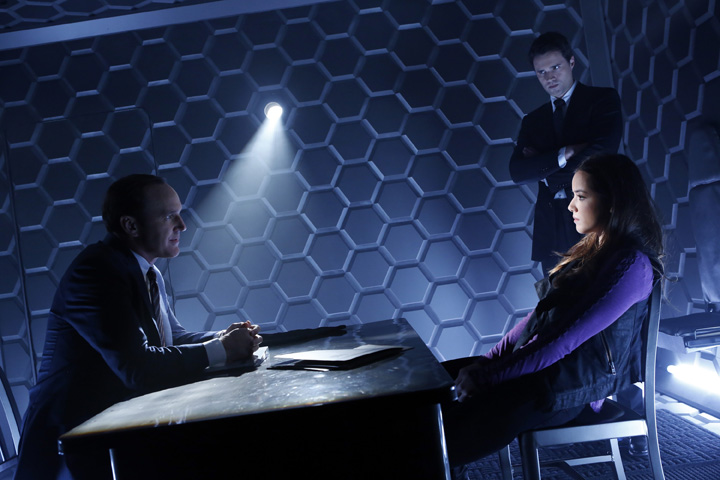
Disney ABC Television Group: Skye's interrogation in the pilot episode.

Don't get me wrong, I love Coulson (he's the only character I'm really attached to), but the character that digital media fans should pay attention to is Skye.  Skye is a self-proclaimed "hacktivist."  We have mentioned this term under digital subcultures but not in depth, so allow me to do an Ishmael and define briefly.

The word hacktivists, you English majors may have guessed, is a hybrid of the terms "hacker" and "activist."  A hacker is someone who hacks computers, an activist is someone who pursues a political cause. A hacktivist, then, seems like someone who is an activist who promotes his or her cause by hacking computers and digital accounts.  One website defines hacktivism as "act of hacking, or breaking into a computer system, for a politically or socially motivated purpose."  Mashable.com "the use of computers and computer networks as a means of protest to promote political ends" and also features a grandiose infographic about the history of hacktivism.  To cite a couple of examples from this infographic, hactivists range from government-sponsored hackers (employed as recently as the war in Syria to keep tabs on certain parties) to underground hackers you may be more inclined to envision when the term comes to mind. Hactivists present a challenge to authority in a sphere--the digital--that governments and other agencies have only limited control over.

courtesy of marsmet tallahassee on flickr


Skye in Marvel's "Agents of S.H.I.E.L.D" falls in the latter category of hacktivists. She is a member of a very sketchy organization called "The Rising Tide" that opposes S.H.I.E.L.D's and other organizations' attempts to hide the truth about top-secret and supernatural events in the world, and she is very vocal about these views in the show.  She is also extremely technologically-savvy, and as a character she is very careful about tying herself to certain sides of a conflict.

In the first episode, Skye is found working independently from a van rennovated to be a communication center, recording messages about how S.H.I.E.L.D. is covering up the truth and how the Rising Tide will thwart them.  S.H.I.E.L.D., inevitably, tracks her down and arrests her for information in a case they are working on, and during her interrogation she boasts that she hacked into their "billions of dollars of equipment" with a laptop she "won in a bet." The line is funny because it's ironic, but it's also true.  In our class as well as in Johnny Evers' lecture about creativity, we have seen examples where enthusiasts and fanatics have outperformed government and commercial research agencies in creating and deploying working technologies such as drones and space probes.  According to Evers' lecture, it was not Steve Jobs who changed the world by himself, but Steve Jobs and a bunch of other obsessed fanatics who worked with him who changed the world.
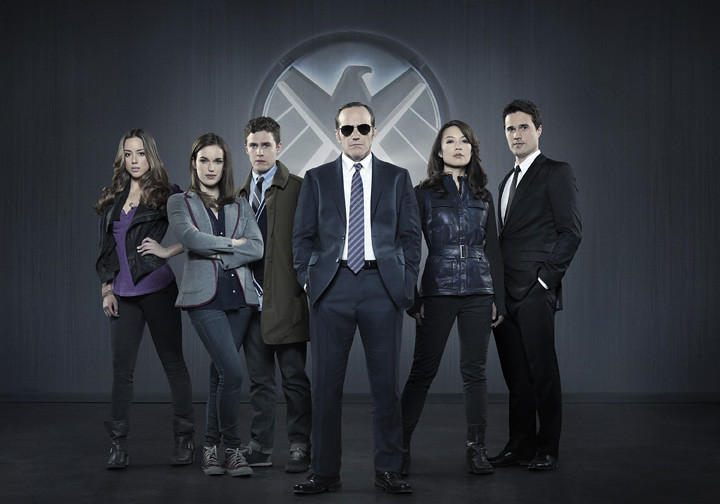
Disney/ABC Television on Flickr. Left to Right: Skye, Simmons, Fitz, Coulson, May, and Ward


Coulson is impressed by Skye's talents, and he sees her as an "asset" and invites her to join his team of S.H.I.E.L.D. agents on their special missions to "protect the world from the weirder world"--an idea opposed to Skye's values, but Skye surprisingly accepts the offer.  None of my friends who are watching the show with me are sure she's entirely trustworthy, but from what I have seen she is using her digital skills to prove herself.  In the second episode, Skye lectures one of the other agents, Ward, about the value of collaboration, and this idea helps the team get out of a literally tight situation.  At the end of the episode, when Coulson asks who idea it was to do such-and-such to save the day, one of the agents says, "it was everyone's idea."  Skye values collaboration because as a hacktivist--someone who knows both computers and political causes--she knows it works in the digital world.  As we very well know, in a movement known as the "Arab Spring" that began a few years ago, several middle eastern governments were toppled by people who banded together through social media and staged successful protests. As Dr. Burton said in our collaboration lecture, it is "no small thing if you can overturn an entire nation with your thumbs."  To quote Skye, "1 person may not have 100% of the solution, but 100 people are more likely to have it."  When people come together through the internet and share their ideas, they learn and solve problems in ways they could not have on their own or in offline company. 

And then in this week's episode, Skye's help was needed in a break-in.  The S.H.I.E.L.D. team was going to Malta to rescue a S.H.I.E.L.D. "asset", but could not land a full break-in squad legally due to international law.  Skye, since she is not yet technically an agent, decides she will go into the manor of the villain billionaire on behalf of the team to help Coulson and Ward break in from the outside.  True to form, she garners an e-vite to a gala at the mansion being held the day of the break-in--and may I add that she did this on her phone while the team is arguing about whether or not she should go--and she introduces herself to the billionaire as a "hactivist."  So from what I have observed of Skye thus far, a hacktivist knows the ins and outs of private and organizational accounts and not only hacks but manipulates the system to get what she wants and make a statement.  Our technology may not be as up-to-speed as it is in the Marvel Universe--touchscreen computer tables, communication earbuds, and instant data access--but it is interesting to see crossovers between that world and ours.

Classmates: I am having friends come over to my apartment to watch the show on Tuesday nights, and if you want to come over let me know!  Marvels "Agents of S.H.I.E.L.D." is on ABC Tuesday nights at 7 local time, or you can watch episodes here: Watch ABC

Friday, October 4, 2013

Midterm #1

My posts for the course so far:

 Hi. I'm Lizy
My introductory blog post.
What's In a Tail?
 Immersion in print versus online.
Me and my Memes
 Memes
I'd Like an Excuse to Post More Memes
 The significance of Memes--Dr. Burton suggested I look into that further. I think I might find a way to tie in memes to my final project. Memes can be very specific to people who are immersed in certain fandoms/cultural groups and have read certain texts.
 Worth Whaling About?
 Real whales, whaling, and our attitude towards the environment. Also posing the question, Is it true that all the information you can find in a book can be more easily found online? Is the reverse true?
The Two-Edged Sword
 The benefits and drawbacks of the use of social media, as evidenced in a Case Study
Another Success Story 
 How fans of Stephanie Nielson's blog reached out to her in a time of need.
Seeing the Good
 Changing my views on the purpose of video games.
 Lizy's Affidavit
Or, proof that Dr. Burton's theory about social proof actually works.
Post-Moby Stress Disorder
Questions about the cultural significance of Moby-Dick and the significance of the white whale. Also, questions about how deeply immersed I am in the story.

I'm seeing a theme of immersion emerging here. I'm not very engaged with digital culture in general, but I am interested in how individuals and societies become immersed in print culture, digital culture, and other media.  Thanks to the information available on the internet, people can become immersed in any topic they chose and discover how to research and recreate their interests.  Not only that, they can use the internet to reach out to other people with similar interests and collaborate in creating larger projects and in gathering to discuss their issues in person.  Significantly, we see this trend occuring in fandoms at events such as comic-cons.

So how deeply can one become immersed in an interest? How does this immersion manifest itself for individuals, in public and across the internet? And how does this affect perception of reality? Is the internet a part of reality, or is it a different reality altogether? Are video games a reality? Books? Physically, yes, these things take up space, but like the TARDIS in Dr. Who they are much, much bigger on the inside than they are on the outside (disclaimer: for the record, I'm not officialy a Dr Who fan, but I have enough Whovian friends to know what I'm talking about when I make this allusion). As technology gets smaller, conversely the world gets bigger. How is this possible? Is this a reflection of how the human mind works?

And considering the similarity to my questions and those being asked by Greg about the depths of reality and virtual reality, I do think I ought to consider collaborating with him.