So I posted the review of my video of Future Shock on google plus, but I forgot to create a blog about it. For some reasons I am having trouble uploading the link on to the blog so here is a link.
The video review of Future Shock I was pretty hard for me, I"m not going to lie. After about twelve takes I reached a point where I realized that because this is my first video, it won't be perfect. For some reason I just felt super self conciouse filming myself, I guess because it was because I was using a new medium.
For being my first video review I think I did a pretty good job, though my ideas could be a little more clearer. I don't think I explained the pain points of the book very well, and if I could do this assinment again, I think that I would write out exactly what I was trying to say as well as the main point that I would want to explain.
Overal, I think that this was an good expereince and excellent assinment to have in this class. I think that most people, including myself, have yet to make a book revie online so for me this was an excellent learning experience.
Showing posts with label bookreview. Show all posts
Showing posts with label bookreview. Show all posts
Friday, November 8, 2013

Monday, November 4, 2013
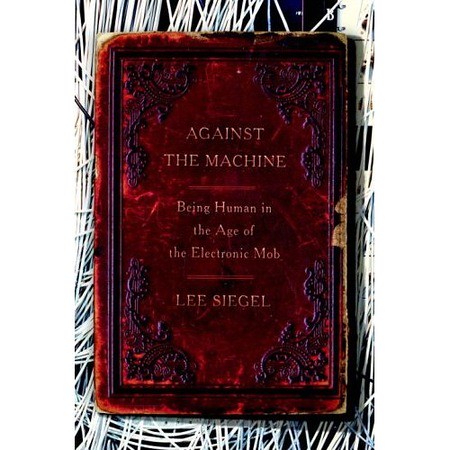
Siegel's Against the Machine: Review
Here is the link to the Goodreads review: https://www.goodreads.com/review/show/742375803
Despite its promising title, Lee Siegel's Against the Machine is less about the struggle to maintain our humanity in the digital age and more about his problem with how the internet age has completely bereft our society of creativity, impartiality, and pure artistic originality.
My very negative preview of Against the Machine was for the most part confirmed by my reading it. It is for the most part poorly written, with a few coherent statements and positive suggestions scattered amongst lengthy commentary on how the internet and its promoters have destroyed our culture and anecdotes about how the internet has turned its consumers or "prosumers" into distorted reflections of itself. He is all about how the internet is people with no talent or originality selling their poor interpretations of things they did not create. Value in this digital society is determined by popularity, not quality or artistry, and value is also based on marketability rather than detached enjoyment. Siegel refers a lot to Alvin Toffler's Future Shock (review by my friend Melee here), making references to how we have become more or less the very society that Toffler predicted. Between the lines of Siegel's ranting is a drawn-out elegy of the death of gatekeeping, regulated print culture, major media outlets and "real" art.
Ironically, although he complains about the bias of our individual-based internet culture, this book is distorted with his own biases, which was disappointing since I chose to read this book based because I thought it promised objectivity. Perhaps in writing this Siegel is presenting his book as an object lesson about how biased our individualized media is. If this is the case, Siegel is trying to imbue us with his own negative perception of humanity and modern culture. He has very little good to say about the internet or the people that use it. Understandably, Siegel wrote this book to reflect on his very negative experiences with the internet. So coming from a completely different perspective--where the internet can also be used as a source of good, uplifting content when created by good people for good reasons--Siegel perhaps would not blame me for thinking that he is missing half the picture.
What good points Siegel does make, as I have pointed out, are few and far between, but I will point them out just so we don't lose faith in the author's humanity. He does have a point that he says that the individualization/customization of the internet is not always a good thing. While it surrounds us with the things we like, however, individualized media insulate us from things we do not like. The internet encourages the glorification of the self and the self's fantasies rather than bringing us closer to understanding other people. Siegel claims that this contributes to the hate, bigotry, and misunderstanding on political blogs, comments, and other internet posts. People just say what they want rather than trying to understand the other person's point of view. I do sympathize with Siegel's claim that detachment from people and media as means to an end is disappearing, but I disagree that it is totally lost--or ever will be lost, from society.
What Siegel could have argued for better, if he argued at all, is a need for limited immersion in the internet culture. Instead, he just rants about the Internet as a corrupt media, an enhanced societal enslavement and a failed democracy, and a culture that has fallen for corporate capitalism's trap. He could have at least offered a solution to today's internet culture, if there is so much wrong with it--after all, in the prologue he says "Things really don't have to be the way they are." So how can they be, Mr. Siegel? Really?
I read this book on Kindle for PC. Against the Machine is divided into three segments with three chapters each. It is fairly short, easy reading.
Despite its promising title, Lee Siegel's Against the Machine is less about the struggle to maintain our humanity in the digital age and more about his problem with how the internet age has completely bereft our society of creativity, impartiality, and pure artistic originality.
My very negative preview of Against the Machine was for the most part confirmed by my reading it. It is for the most part poorly written, with a few coherent statements and positive suggestions scattered amongst lengthy commentary on how the internet and its promoters have destroyed our culture and anecdotes about how the internet has turned its consumers or "prosumers" into distorted reflections of itself. He is all about how the internet is people with no talent or originality selling their poor interpretations of things they did not create. Value in this digital society is determined by popularity, not quality or artistry, and value is also based on marketability rather than detached enjoyment. Siegel refers a lot to Alvin Toffler's Future Shock (review by my friend Melee here), making references to how we have become more or less the very society that Toffler predicted. Between the lines of Siegel's ranting is a drawn-out elegy of the death of gatekeeping, regulated print culture, major media outlets and "real" art.
 |
| Adam Thierer, Flickr |
What good points Siegel does make, as I have pointed out, are few and far between, but I will point them out just so we don't lose faith in the author's humanity. He does have a point that he says that the individualization/customization of the internet is not always a good thing. While it surrounds us with the things we like, however, individualized media insulate us from things we do not like. The internet encourages the glorification of the self and the self's fantasies rather than bringing us closer to understanding other people. Siegel claims that this contributes to the hate, bigotry, and misunderstanding on political blogs, comments, and other internet posts. People just say what they want rather than trying to understand the other person's point of view. I do sympathize with Siegel's claim that detachment from people and media as means to an end is disappearing, but I disagree that it is totally lost--or ever will be lost, from society.
What Siegel could have argued for better, if he argued at all, is a need for limited immersion in the internet culture. Instead, he just rants about the Internet as a corrupt media, an enhanced societal enslavement and a failed democracy, and a culture that has fallen for corporate capitalism's trap. He could have at least offered a solution to today's internet culture, if there is so much wrong with it--after all, in the prologue he says "Things really don't have to be the way they are." So how can they be, Mr. Siegel? Really?
 | ||||
| occidentalobserver.net |
Alvin Tofler's: Future Shock

https://www.goodreads.com/review/show/757000290
Living in a society that is centered on
technology, I have always been interested in learning more about how this
technological age we live in effects us as individuals, families, and as a
society. Alvin Toffler within his book Future Shock address within this book
the change that is happening within our society as the pace is constantly being
sped up through technology. Toffler in his book goes on to explain the consequences
and the future shock that can occur while living in living in a fast pace society due to
technology. Though this book was written over 30 years ago, the concepts and
issues that Alvin Toffler addresses within his book Future Shock are still
applicable today.
Future Shock was an interesting read as Alvin
Toffler tackles complex issues and topics as he seeks to answer the question
posed in his book “How can we prevent mass future shock, selectively adjusting
the tempos of change” (395). One of the
issues he address within his book ,concerning the negative consequences of
living in such a fast paced world, is the effect this will have on the family
as a whole. Toffler examines how because
the pace within society gets faster and faster, the process when it comes to
growing up, leaving home, getting married, and starting a family will become in
a way so rushed that Toffler suggests that this process will become so rushed
that he says that marriage will become in a way non-existent.
Though the book was a slow read in the beginning,
Toffler manages to introduce various topics and aspects of the effect of living
in a continually increasingly fast paced society. I feel that though this was written some time
ago, today as a society we are still seeking answers to many of the questions
that are brought up within Future Shock.
Overall, I would recommend this book because it is an interesting read
and the concerns are still applicable today.
Wednesday, October 23, 2013
The Effects of Technology and Alvin Toffler"s Future Shock
It will be interesting to read about the concerns society had concerning the effect that technology has on the individual, the family and society as a whole in the 1970's. It will be interesting to see if those concerns remain the same today, or if our concerns today differ thirty years ago.
Preview:
While looking over the table of continents it is evident that Alvin Toffler divides his book into three sections: Pre-technology age, the technology age, and the future of technology. It is evident that Toffler will address the historical age before technology was invented , the technology age within the 70's, and his opinions of the effect technology has on individuals and society, and the way it may effect everybody in the future.
Early Social Proof
I"m excited because one person has liked my post on Google+ and I think that in general people are very interested in the effect technology has on people(take for example video game addictions). After talking to my friend about what they think about both the positive and negative effects technology has on people and society, it clearly something that people think about given that though this book was written over thirty years ago, we are still trying to address the concepts that the book is addressing.
Similar Books
While searching for similar books to Toffler, there was one author Doughlas Rushkoff who wrote "Present Shock" that was repeatedly recommended on the recommend list on may books. Nicholas Carr was also a repeated author that was recommended.
Who Cares?
Apparently Alvin Toffler is very popular when it comes to subjects on technology. Many people on both twitter and Google Plus were talking about him and his works. One of the quotes that were repeatedly quotes on both of these social mediums was the quote " “Illiteracy will not be defined by those who cannot read and write, but by those who cannot learn and relearn.” So apparently some of the concerns from the past are still very applicable today. There was also a wide variety of people reading and reviewing his work, people that ranged from the college student to the high school student to some random old person reading it to understand technology better.
Formal Reviews
There were a variety of recent reviews of "Future Shock" the Daily Bankruptcy Review
had a very positive review of how his book was very applicable today. Other reviews such as Forbes Forbes Future Shock: Why Alvin Toffler Was Wrong review do not agree with the ideas Alvin Toffler present. Having these two very well known magazines and websites review Tofflers work with two very distinctly different opinions was both surprising and exciting. It is clear through reading reviews that people have a lot of opinions about technology and its effect, but also about the ideas that Toffler presented within his book.
Multimedia
A technical college in Kentucky used "Future Shock" within their syllabus as well as the University of Hawaii, both of which were very recent. After looking it up on multiple sites such as flickr and Vimeo, it is seriously everywhere. People where showing it on their bookshelves, they made little videos about it on Vimeo, there was also tons of youtube videos about the book and its contents. It is just interesting to see the effect this book has had, so much to the degree that even today people are still interested in Toffler's ideas.
First Impressions of the Book
After reading the book for an hour I was drawn to a chapter near the end of the book called "Coping With Tomorrow. In this chapter Toffler explains that despite how people view technology(both positive and negative) its important from time to time to take a step back from it. He explains that " there are definite limits to the amount of newness that any individual group can absorb in a short span of time, regardless of how well integrated the whole may be(329).
My Thinking So Far
After completing all of the steps and getting a good review of this book and the feedback it has already received online, I am definitely ready and excited to read the whole thing. While completing this process, I think for me personally it has changed the way I will read this book. In particular, the review I read were helpful in helping me create my own ideas, as well as helping me see both sides of the spectrum by introducing to me both positive and negative reactions towards this book.
Preview:
While looking over the table of continents it is evident that Alvin Toffler divides his book into three sections: Pre-technology age, the technology age, and the future of technology. It is evident that Toffler will address the historical age before technology was invented , the technology age within the 70's, and his opinions of the effect technology has on individuals and society, and the way it may effect everybody in the future.
Early Social Proof
I"m excited because one person has liked my post on Google+ and I think that in general people are very interested in the effect technology has on people(take for example video game addictions). After talking to my friend about what they think about both the positive and negative effects technology has on people and society, it clearly something that people think about given that though this book was written over thirty years ago, we are still trying to address the concepts that the book is addressing.
Similar Books
While searching for similar books to Toffler, there was one author Doughlas Rushkoff who wrote "Present Shock" that was repeatedly recommended on the recommend list on may books. Nicholas Carr was also a repeated author that was recommended.
 |
| "The Shallows: What The Internet is Doing to Our Brains" Nicholas Carr |
 | ||
| "Present Shock" by Doughlas Rushoff |
 | |||||
| "The Digital Divide: Arguments for and against Facebook, Google, Texting, and the age of Social Networking" |
Apparently Alvin Toffler is very popular when it comes to subjects on technology. Many people on both twitter and Google Plus were talking about him and his works. One of the quotes that were repeatedly quotes on both of these social mediums was the quote " “Illiteracy will not be defined by those who cannot read and write, but by those who cannot learn and relearn.” So apparently some of the concerns from the past are still very applicable today. There was also a wide variety of people reading and reviewing his work, people that ranged from the college student to the high school student to some random old person reading it to understand technology better.
Formal Reviews
There were a variety of recent reviews of "Future Shock" the Daily Bankruptcy Review
had a very positive review of how his book was very applicable today. Other reviews such as Forbes Forbes Future Shock: Why Alvin Toffler Was Wrong review do not agree with the ideas Alvin Toffler present. Having these two very well known magazines and websites review Tofflers work with two very distinctly different opinions was both surprising and exciting. It is clear through reading reviews that people have a lot of opinions about technology and its effect, but also about the ideas that Toffler presented within his book.
Multimedia
A technical college in Kentucky used "Future Shock" within their syllabus as well as the University of Hawaii, both of which were very recent. After looking it up on multiple sites such as flickr and Vimeo, it is seriously everywhere. People where showing it on their bookshelves, they made little videos about it on Vimeo, there was also tons of youtube videos about the book and its contents. It is just interesting to see the effect this book has had, so much to the degree that even today people are still interested in Toffler's ideas.
First Impressions of the Book
After reading the book for an hour I was drawn to a chapter near the end of the book called "Coping With Tomorrow. In this chapter Toffler explains that despite how people view technology(both positive and negative) its important from time to time to take a step back from it. He explains that " there are definite limits to the amount of newness that any individual group can absorb in a short span of time, regardless of how well integrated the whole may be(329).
My Thinking So Far
After completing all of the steps and getting a good review of this book and the feedback it has already received online, I am definitely ready and excited to read the whole thing. While completing this process, I think for me personally it has changed the way I will read this book. In particular, the review I read were helpful in helping me create my own ideas, as well as helping me see both sides of the spectrum by introducing to me both positive and negative reactions towards this book.
Lee Siegel's Against the Machine and the Digital World
Title: Against the Machine: Being Human in the Age of the Electronic Mob.
I want to explore the more human side of digital culture, what media people use, how, why, and how they create, share, and interact in digital worlds. I am told that Lee Siegel's Against the Machine is about how the internet has changed humanity's minds and culture. The categories of technology, communications, and commerce are now so intertwined that it is hard to tell where one begins and another ends. The fact that there are loss of distinctions and challenges to human identity is important to me. What is Siegel's argument and is he right? How has the digital changed human culture?
Preview:
In the Introuction, Siegel comes right out and identifies a reciprocal relationship between human culture and the internet. He also identifies himself as a cultural critic with the mantra "Things really don't have to be the way they are." From what I gather from the rest of the book, Siegel isn't trying so much to debunk myths about internet culture (which he does in some cases) as he is to put the internet in a human context. It is obvious that he's trying to make you think twice about the mainstream, but does he actually propose any viable solutions? Maybe I saw one while skimming through but didn't realize it was what I was looking for. Siegel uses a lot of snappy chapter titles and sub-headings and frequent pop culture examples throughout the text--something I think I might enjoy.
Social Proof:
Posted a new discussion on Goodreads exactly three hours ago. No activity. Shared update on Google +. No activity. Shared Facebook status. No activity. Guess I should have gone on Twitter after all.
But tonight's episode of Marvel's Agents of S.H.I.E.L.D. had an interesting storyline. Skye (our hacker heroine) reunites with an ex-boyfriend/fellow hacktivist whose name I think is Miles. Skye defends Miles from her new friends by saying that he is an idealist who believes in the freedom of ideas...but then her friends find out that he sold information to an evil organization for a million dollars. Skye is definitely turned off (as she should be) but Miles defends himself by saying that he can't make a living off his beliefs in free expression alone. I recall Siegel discussing the ideas about information democracy in his book. Not exactly social proof, or maybe it's social proof from Joss Whedon. Maybe I should watch out for copyright wars information and get more info on that. What is Siegel's position? How does this tie into digital culture?
Friends of Against the Machine.
To Amazon first. Top results: Siegel wrote Harvard is Burning and Falling Upwards: Essays in Defense of the Imagination. This latter option intrigues me. Item added to wish list. Siegel also wrote Are You Serious? How to Be True and Get Real in the Age of Silly. Siegel appears to be an authority on contemporary/digital culture. His books are linked to books debating the relationship between technology and society. En route to Google Books I notice that on the search for "against the machine lee siegel" my Google + post from early is number eleven on google search--that's either really good or really bad. The Google books link is right above that, number 10. The only repeated author on either Amazon or Google is Siegel himself. Siegel also wrote Not Remotely Controlled, Fires of Love--Waters of Peace, iand Love and the Incredibly Old Man, a novel. His non-fiction books are very culture oriented.
The Social Context
On Google +, it's quality over quantity. Two years ago, someone shared a video of a TED talk related to the ideas in Siegel's book. And just over a year ago someone shared to a link of an article by Siegel talking about parenting issues in technology use.
Twitter Search: No one has talked about this book on twitter since 2011. The very bottom tweet called it "the first credible book to criticize the digital age." Found a tumblr link that quotes an email saying Siegel argues that the digital age has turned "privacy into performance, play into commerce, and confused 'self-expression' with art". Found a link to a very negative amateur review that will be revisited later. The author himself is very active on Twitter.
Formal Reviews:
The New York Times 2008 book review reveals that Against the Machine was written in response to a controversy over being "pilloried" by the web because he "respond[ed] to comments about him posted on his blog at The New Republic’s Web site." Ouch. Am I supposed to expect an angry rant? "Siegel sees the Internet as 'the first social environment to serve the needs of the isolated, elevated, asocial individual.'" That makes sense. The reviewer points out the fallacy that Siegel neglects the internet culture outside of the US and is overly displeased with Siegel's biased, angry stance. Lower on the Google search page is a link to a review by the Technology Liberation Front, an organization with a communist color scheme on their website and dedicated to keeping the government off the internet and out of all things technology. There is a review of Against the Machine individually as well as grouped with other books about optimistic and pessimistic views about the internet, which is also linked to another article about internet optimists and pessimists in general. On this site, Adam Thierer argues that the debate over new technologies and their impact on society is nothing new, in fact it is cyclical. He divides thinkers into "optimist" and "pessimist" camps. He argues that the optimists are in the lead but need to be a little less romantic, and that the pessimists need to be less hysterical. Thierer argues that the preferred approach ought to be "pragmatic optimism." Thierer catagorizes Siegel as a pessimist along with these titles I have heard before: Andrew Keen's The Cult of the Amateur, Nick Carr's The Shallows, and Jaron Lanier's You Are Not A Gadget. Thierer categorizes pessimists as believing that the internet is polarizing, fragmentary, and anti-democratic. Thierer describes Against the Machine as "the dourest of the recent books that have adopted a pessimistic view of the impact the Internet is having on our culture, society, and economy" but also "one of the most important technology policy books of 2008." According to Thierer, Siegel is concerned about the loss of truth and authority on the internet, views user-generated content with contempt, and that most people want money/recognition from their internet activities. Thierer accuses Siegel of not looking at the benefits of Web 2.0. Professional reviewers are quoted on Amazon as praising his writing style the most.
Informal Reviews:
First, the Review I found on Twitter: Sarah D. Bunting on Tomato Nation in 2011. Bunting also takes issue with Siegel's negativity. Most Goodreads reviews gave Against the Machine a rating of 3 stars or less. The top reviewer on Goodreads states that Siegel's argument is that the internet is using us and the commercial Web has an agenda to take advantage of us, and the text fails to deliver on the promising title. Even the most positive reviewer argued that he could have used more positive examples. Another reviewer says he contradicts himself at times--well, there could be a trickster element to this book, I wouldn't be surprised. Most Google Books readers gave it a 3 stars or less rating. The average rating on Amazon is 3.5 stars. The most helpful review called it "a cautionary tale." The Amazon reviewers believe this book had a potenitally good idea that failed. Ouchihuahua.
Can't find anything on Against the Machine in college courses.
Multimedia
I have already found this YouTube video and a Newsweek Article . Here is an interview Siegel did with New York Magazine. It turns out the YouTube video is a TED talk. The speaker said that the internet's algorithms are tailored so that we get personalized search results rather than access to a variety of information, news, and entertainment. He uses the phrase "internet of one" towards the end of his speech. The reason I found this video was because the girl who linked it said that Against the Machine predicted it. While this is true economically, this could also be a model for internet behavior in general. The Newsweek article is about parental involvement in children's online safety, and includes a video interview with Siegel himself. The argument is that children's internet activities do need to be monitored by parents, that children are just as vulnerable to online marketing as to online predators, but sometimes parents are also caught unawares in internet activities and put their children at risk. Unfortunately the video will not play. As for the interview, Siegel says he wishes people would get over the blog incident that led to his writing the book in the first place. He says, "I love the Internet, I’m on it all the time. I couldn’t have written the book so quickly without it. But I think that its claims for greater social connectivity are a sham. I don’t think it’s making people more connected than they were before, not at all." He is not opposed to amateurs but hates how the internet treats all amateurs like professionals. So perhaps he is not quite as pessimistic as the reviewers think--he's just picky. He is pointing out what he thinks the internet is doing wrong.
1 Hour's Worth of Reading
In the space of an hour, I read chapters 3, 4, and 7. True to the reviews, Siegel is always going back to how the Internet was made for marketing and how people who "express themselves" online are really just rehashing what someone else has said in order to gain popularity and sell their leisure time. I would definitely classify Siegel as a pessimist. He is trying to be objective, but he is constantly returning to the same ideas. This book is part book review of other works on the internet and modern culture and part tempered rant. But he does say a few things that I could look into, stuff about the nature of art and remix, and also about the real "freedom" of the internet experience.
My Thinking So Far:
I wish I'd read something else. Siegel is informative but not objective. I wanted something a little deeper. I think I would still like to read this book but I want to find other books with differing or at least tempered viewpoints.
I want to explore the more human side of digital culture, what media people use, how, why, and how they create, share, and interact in digital worlds. I am told that Lee Siegel's Against the Machine is about how the internet has changed humanity's minds and culture. The categories of technology, communications, and commerce are now so intertwined that it is hard to tell where one begins and another ends. The fact that there are loss of distinctions and challenges to human identity is important to me. What is Siegel's argument and is he right? How has the digital changed human culture?
Preview:
In the Introuction, Siegel comes right out and identifies a reciprocal relationship between human culture and the internet. He also identifies himself as a cultural critic with the mantra "Things really don't have to be the way they are." From what I gather from the rest of the book, Siegel isn't trying so much to debunk myths about internet culture (which he does in some cases) as he is to put the internet in a human context. It is obvious that he's trying to make you think twice about the mainstream, but does he actually propose any viable solutions? Maybe I saw one while skimming through but didn't realize it was what I was looking for. Siegel uses a lot of snappy chapter titles and sub-headings and frequent pop culture examples throughout the text--something I think I might enjoy.
Social Proof:
Posted a new discussion on Goodreads exactly three hours ago. No activity. Shared update on Google +. No activity. Shared Facebook status. No activity. Guess I should have gone on Twitter after all.
But tonight's episode of Marvel's Agents of S.H.I.E.L.D. had an interesting storyline. Skye (our hacker heroine) reunites with an ex-boyfriend/fellow hacktivist whose name I think is Miles. Skye defends Miles from her new friends by saying that he is an idealist who believes in the freedom of ideas...but then her friends find out that he sold information to an evil organization for a million dollars. Skye is definitely turned off (as she should be) but Miles defends himself by saying that he can't make a living off his beliefs in free expression alone. I recall Siegel discussing the ideas about information democracy in his book. Not exactly social proof, or maybe it's social proof from Joss Whedon. Maybe I should watch out for copyright wars information and get more info on that. What is Siegel's position? How does this tie into digital culture?
Friends of Against the Machine.
To Amazon first. Top results: Siegel wrote Harvard is Burning and Falling Upwards: Essays in Defense of the Imagination. This latter option intrigues me. Item added to wish list. Siegel also wrote Are You Serious? How to Be True and Get Real in the Age of Silly. Siegel appears to be an authority on contemporary/digital culture. His books are linked to books debating the relationship between technology and society. En route to Google Books I notice that on the search for "against the machine lee siegel" my Google + post from early is number eleven on google search--that's either really good or really bad. The Google books link is right above that, number 10. The only repeated author on either Amazon or Google is Siegel himself. Siegel also wrote Not Remotely Controlled, Fires of Love--Waters of Peace, iand Love and the Incredibly Old Man, a novel. His non-fiction books are very culture oriented.
The Social Context
On Google +, it's quality over quantity. Two years ago, someone shared a video of a TED talk related to the ideas in Siegel's book. And just over a year ago someone shared to a link of an article by Siegel talking about parenting issues in technology use.
Twitter Search: No one has talked about this book on twitter since 2011. The very bottom tweet called it "the first credible book to criticize the digital age." Found a tumblr link that quotes an email saying Siegel argues that the digital age has turned "privacy into performance, play into commerce, and confused 'self-expression' with art". Found a link to a very negative amateur review that will be revisited later. The author himself is very active on Twitter.
Formal Reviews:
The New York Times 2008 book review reveals that Against the Machine was written in response to a controversy over being "pilloried" by the web because he "respond[ed] to comments about him posted on his blog at The New Republic’s Web site." Ouch. Am I supposed to expect an angry rant? "Siegel sees the Internet as 'the first social environment to serve the needs of the isolated, elevated, asocial individual.'" That makes sense. The reviewer points out the fallacy that Siegel neglects the internet culture outside of the US and is overly displeased with Siegel's biased, angry stance. Lower on the Google search page is a link to a review by the Technology Liberation Front, an organization with a communist color scheme on their website and dedicated to keeping the government off the internet and out of all things technology. There is a review of Against the Machine individually as well as grouped with other books about optimistic and pessimistic views about the internet, which is also linked to another article about internet optimists and pessimists in general. On this site, Adam Thierer argues that the debate over new technologies and their impact on society is nothing new, in fact it is cyclical. He divides thinkers into "optimist" and "pessimist" camps. He argues that the optimists are in the lead but need to be a little less romantic, and that the pessimists need to be less hysterical. Thierer argues that the preferred approach ought to be "pragmatic optimism." Thierer catagorizes Siegel as a pessimist along with these titles I have heard before: Andrew Keen's The Cult of the Amateur, Nick Carr's The Shallows, and Jaron Lanier's You Are Not A Gadget. Thierer categorizes pessimists as believing that the internet is polarizing, fragmentary, and anti-democratic. Thierer describes Against the Machine as "the dourest of the recent books that have adopted a pessimistic view of the impact the Internet is having on our culture, society, and economy" but also "one of the most important technology policy books of 2008." According to Thierer, Siegel is concerned about the loss of truth and authority on the internet, views user-generated content with contempt, and that most people want money/recognition from their internet activities. Thierer accuses Siegel of not looking at the benefits of Web 2.0. Professional reviewers are quoted on Amazon as praising his writing style the most.
Informal Reviews:
First, the Review I found on Twitter: Sarah D. Bunting on Tomato Nation in 2011. Bunting also takes issue with Siegel's negativity. Most Goodreads reviews gave Against the Machine a rating of 3 stars or less. The top reviewer on Goodreads states that Siegel's argument is that the internet is using us and the commercial Web has an agenda to take advantage of us, and the text fails to deliver on the promising title. Even the most positive reviewer argued that he could have used more positive examples. Another reviewer says he contradicts himself at times--well, there could be a trickster element to this book, I wouldn't be surprised. Most Google Books readers gave it a 3 stars or less rating. The average rating on Amazon is 3.5 stars. The most helpful review called it "a cautionary tale." The Amazon reviewers believe this book had a potenitally good idea that failed. Ouchihuahua.
Can't find anything on Against the Machine in college courses.
Multimedia
I have already found this YouTube video and a Newsweek Article . Here is an interview Siegel did with New York Magazine. It turns out the YouTube video is a TED talk. The speaker said that the internet's algorithms are tailored so that we get personalized search results rather than access to a variety of information, news, and entertainment. He uses the phrase "internet of one" towards the end of his speech. The reason I found this video was because the girl who linked it said that Against the Machine predicted it. While this is true economically, this could also be a model for internet behavior in general. The Newsweek article is about parental involvement in children's online safety, and includes a video interview with Siegel himself. The argument is that children's internet activities do need to be monitored by parents, that children are just as vulnerable to online marketing as to online predators, but sometimes parents are also caught unawares in internet activities and put their children at risk. Unfortunately the video will not play. As for the interview, Siegel says he wishes people would get over the blog incident that led to his writing the book in the first place. He says, "I love the Internet, I’m on it all the time. I couldn’t have written the book so quickly without it. But I think that its claims for greater social connectivity are a sham. I don’t think it’s making people more connected than they were before, not at all." He is not opposed to amateurs but hates how the internet treats all amateurs like professionals. So perhaps he is not quite as pessimistic as the reviewers think--he's just picky. He is pointing out what he thinks the internet is doing wrong.
1 Hour's Worth of Reading
In the space of an hour, I read chapters 3, 4, and 7. True to the reviews, Siegel is always going back to how the Internet was made for marketing and how people who "express themselves" online are really just rehashing what someone else has said in order to gain popularity and sell their leisure time. I would definitely classify Siegel as a pessimist. He is trying to be objective, but he is constantly returning to the same ideas. This book is part book review of other works on the internet and modern culture and part tempered rant. But he does say a few things that I could look into, stuff about the nature of art and remix, and also about the real "freedom" of the internet experience.
My Thinking So Far:
I wish I'd read something else. Siegel is informative but not objective. I wanted something a little deeper. I think I would still like to read this book but I want to find other books with differing or at least tempered viewpoints.
Tuesday, October 22, 2013
Exploring the benefit of digital sharing for the LDS church in Public Parts by Jeff Jarvis
With my personal experience serving my mission for The Church of Jesus Christ of Latter-day Saints at Temple Square and using digital tools to do missionary work, I have been fascinated with the potential that the digital world offers for sharing the gospel of Jesus Christ. I am reading Jeff Jarvis's book Public Parts with the hope to gain some insight into just how effective digital sharing can potentially be. I have a personal desire to continue to share what has made a large impact on my own personal life, and feel that a greater understanding of how digital media and sharing impacts our day to day life will allow me to accomplish that.

Preview
After spending some time browsing through Public Parts, I can see that Jeff Jarvis is going to cover in detail, the different benefits that he believes the public sphere provides. That being said, he also discusses the boundaries between private and public, and how much is too much. Jarvis also goes through history as a means to discuss public sharing, discussing the printing press, as well as how the introduction of basic technology affected everyday life. I'm happy to see that Jarvis discusses specific social media platforms, and the benefits that they individually possess.
Early Social Proof
Unfortunately I didn't get any responses to my initial posts about my plans for research combined with this book. However, I contacted several mission friends, and spoke with other friends who served missions as well, and they shared interest in my plans. Whether or not they were involved directly with using the internet to share the gospel while they were full-time missionaries, they saw the influence it had on others, and how many people's first exposures to the church were online. If anything, I now know that there is interest in my purpose!
Similar Books
As I browsed through the other books recommended on Amazon, it seems that a common topic is examining how social media in particular can drive social change. Jarvis's other book What Would Google Do? also popped up when searching on several different sites. Privacy concerns are also a big issue and topic, and it would be interesting to read some of these other books to see how their arguments compare with the one made by Jarvis in Public Parts.
Who Cares?
As I explored the conversation going on concerning Jarvis and this book, I discovered that Jarvis himself is very active on twitter. There was a lot of conversation going on between himself and others who appear to be fans of his book, and interested in learning the balance of the digital world. A lot of the discussion going on online is due to Jarvis's online presence. He has posted videos and has his own website and is very active online, which creates an opportunity for lots of discussion, on twitter, google+, etc. I also found Jarvis on storify!
Formal Reviews
Fortune reviewed the book, and I found the review extremely encouraging! They wrote, "Privacy has its advocates. Jeff Jarvis has made himself an advocate for publicness. In Public Parts, the original Internet optimist argues that if we become too obsessed with guarding al personal information on the 'Net, we'll miss important opportunities that come. with making information available." I found it interesting that Jarvis is referred to as the "original internet advocate". It seems that he is a credible figure on the topic. As I continued to read reviews by other papers and magazines, I've come to realize that Jarvis is very much an activist on the topic. USAToday refers to him "often taking corporatiosn and governments to task for assaults, as he sees them, on teh openness of the Internet." I'm gad to see that Jarvis is an authority on Internet publicness.
Informal Reviews
I found a review by Tim Peter who commented on the position this book plays among other business literature. He recommended a specific chapter for those interested in the internets affect on marketing, and I'm interested to start my reading later on in that chapter. He also mentioned that Jarvis keeps things funny! So I'm looking forward to that. On Goodreads, many of the reviewers commented that they read the book on audiobook and that it was fantastic. I was happy to see that both people who agreed with Jarvis's point of view, and those who disagreed both found the book informative. A reader named Terry praised the book for it's well formulated argument and the logical soundness of the book. I'm excited to read!
Educational Courses
I found that at Harvard the Berkman Center for Internet and Society uses this book and other lectures by Jarvis. I found some videos of Jeff Jarvis lecturing on their website that look interesting. UMBC had videos of him posted in their curriculum as well, and I learned that Jarvis is a professor of journalism at City University of New York.
Multimedia
While Jeff Jarvis is extremely preset online, posting his own photos, video, etc., I found many photos on flickr and other sites of him lecturing at various conferences. Many also made video reviews of the book, which I was able to listen to. I am excited to see that this is an ongoing discussion, which Jarvis himself is participating even after the book. I'm beginning to recognize how society will need to adapt and change before online sharing is the ultimate norm. I'm excited to see what this means for the LDS church moving forward.
First Impressions of the Book
After my initial research, I began reading in the chapters that focused on the benefits of public sharing, as I wanted to see what his argument was founded on. It was fascinating to see examples from all across the spectrum, not just social media companies, but from healthcare companies, government organizations, etc. as well. His arguments regarding the value of forming relationships and connections and how these relationships essentially "brand" and organization support my initial ideas regarding the continued use of digital media to share the gospel for the LDS church. I'm beginning to realize the "what" and "how" of sharing is something I don't understand as well as the "why", and I'm looking forward to continuing to learn more about that as I read.
My Thinking So Far
As I was reading I kept feeling that as I research this I need to be applying what Jarvis is advocating-I need to be more public. Not in the sense of posting my meals and daily schedule, but in regards to my research, and even my own experience with missionary work and digital culture, I need to be more open and public. I'm hoping to get in contact (via the internet) with missionaries I personally served with, as well as with other friends who have served missions or who have been exceptionally diligent at sharing the gospel online. I want to gather their thoughts and opinions in regards to this topic and actually experience the book as I read it.
Subscribe to:
Posts (Atom)