Showing posts with label posted by Lizy. Show all posts

Tuesday, December 3, 2013

Lizy's Project Proposal about S.H.I.E.L.D.

Title: (Currently) Marvel's "Agents of S.H.I.E.L.D." as an Emerging Fandom: A Study in Fan Culture.

Thesis: Marvel's new television series "Agents of SHIELD" will succeed based on how it is projected through online media by digital fan communities.  Digital fan communities help fans navigate their immersion in a fandom to find meanings within their entertainment through online discussion and remixed content.  Fandoms grow better when their fans share content with their friends.  Dr. Wickman suggested I look at the scholarship on immersion and see how it compares to what I am seeing in fan culture.

Relevance:  Marvel's "Agents of S.H.I.E.L.D. is only in its first season.  In terms of both its episodes and its relationship with the fans, it has been dynamic.  It is part of the larger Avengers and Marvel fandom and one of the show's main producers is cult favorite Joss Whedon.  If there was any time to examine a possible fandom in the act of forming, this is the moment.  There is a lot of potential for the show and a lot of tension in the fan community.

Format:  I am thinking a formal essay, except maybe with picture snapshots of twitter and facebook posts.  Maybe I could go multimedia--not for the formal paper but the final blog post or something.

Curation of Content:  I started snipping pictures of Facebook and Twitter posts over break.  It will keep up.  I am also accumulating reviews of the show and fandom articles on Zotero.

Curation of Secondary Sources: I have read/am reading books about the Star Trek and Dr. Who fandoms.  I also have a few scholarly articles which I have curated via Google Docs and Zotero (I got it for Dr. Burton's Shakespeare Class--it's awesome!)

Curation of Community: I am following SHIELD fan sites on Twitter, the Helicarrier podcast and Agent Coulson's Army, and they in return are following me.  I am being followed by PhantasticGeek on Twitter. I follow the official SHIELD sites on Twitter and Facebook and most of the show's actors on Twitter.

Social Proof:  I normally watch SHIELD with my roommates and one or two friends, so I can talk to them about it.  I also have a guy friend CJ in the medieval club who likes the show (I mean, a lot of clubbies like the show, but CJ especially).  And then I am in contact with Jason Hamilton who is an expert on fandoms in general.
People I don't know directly:  I exchanged emails with I also tweeted the author of a Buzzfeed article about the Marvel Cinematic Universe's big impact on Hollywood.

Venue:  
So I just found this huge blog page about scholarly blogs and journals devoted to fandom studies.  Here is the link if my classmates or other interested parties want it: http://fanstudies.wordpress.com/fan-studies-journals/

Of the ones listed above, I want to submit to Participations, which is a journal of audience reception studies. Their organization exists because (quote from website) "we recognise that these fields are not at present well-supported within the broad academic communities. There are few undergraduate courses and even fewer postgraduate courses which emphasise this work. Only a small number of research students work in this area, compared to other kinds of work on all the many forms of cultural and media expression. Yet we believe that the findings of audience and reception work are of crucial importance to all our fields – not least because claims about the audience are so frequently embedded within other kinds of work, and within public discourses about media and culture."  

So it sounds like mine is the kind of paper they are looking for.
I would also like to submit to Transformative Works and Cultures, since it deals more specifically with fandoms.
The real challenge I am setting for myself is The Journal of Science Fiction Film and Television, which is published by Liverpool University Press IN THE UK!!!!!!!  More likely than not, if I got accepted to a conference they put on I'd have to do a video conference, but hey, it would still be cool.  The guidelines say I have to use UK grammar and spelling and also use specific citations for TV shows and actors.  My response:

self-generated meme.
What I need to do next:

Go through the Dr. Who fandom book I read over the break and comb for quotes.
Create an orderly history of FB comments and twitter quotes (also block out names).
Listen to the Helicarrier podcast
Post link to this blog and "Tweethis" statement to social media sites.  Ask fans about their views of fandom and S.H.I.E.L.D.
Start writing out the paper
Curate fan art and memes specifically related to SHIELD.
FIND SCHOLARLY ARTICLES ABOUT:
humor
fandoms and immersion
FIND SCHOLARLY ARTICLES BY:
Henry Jenkins
Cheryl Harris
get fandom books renewed at library
Find more recent SHIELD reviews


Friday, November 22, 2013

Final Project: How it's Looking right Now. Feedback Welcome

A thesis is like a scientific equation.  You need certain elements to come together to create a certain product. I am not entirely sure what the final product is going to be.  But I am now going to take this opportunity to lay out my ingredients on the table to see what I have and will likely end up with. This is not my final thesis and venue, but just me thinking through my ideas.  Lots of feedback would be welcome.

I want to somehow respond to my ideas on immersion from the midterm.  A good secondary term for immersion is engagement.  Using the terms more or less interchangeably, I define an individual's engagement or immersion within a fandom as a relationship with a fandom with the end goal of promoting a change change of value within the fandom, either for oneself or for the fan community.  Open immersion adheres to the values of the fan community and compromises with them to create value.  Closed immersion is only interested in the individual's veiw of how a fandom/fans should exist or behave and seeks to tear them down.

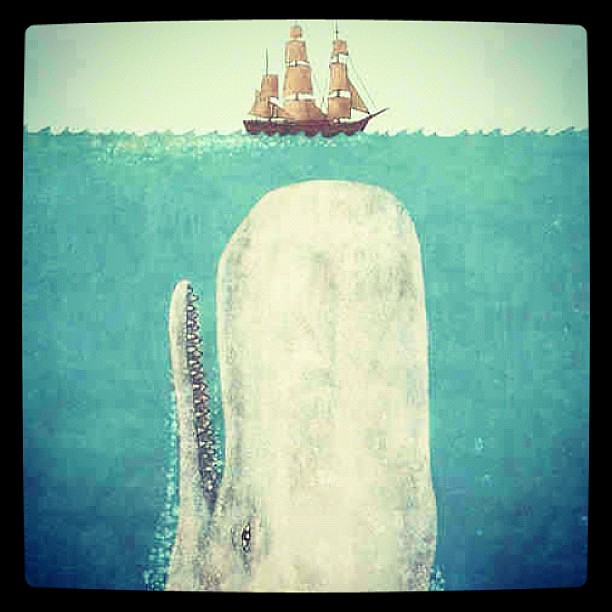
I also want to return to the idea of memes.  A fandom is a meme or contagious idea, as are the social morays within them.  Cultures have their own distinctive symbols, such as the harpoon or the line to Moby Dick's whalers, or Captain America's shield in the Avengers films.  Like these more physical symbols, there are also internal ideas that spread and change within a culture, like a whaling captain's responsibility to his crew or, to use an Avengers example, "COULSON LIVES!" It can be as simple as a joke or a motto, or as complex as a value judgment about a certain topic delivered by a community or an individual.  I want to understand how memes spreading within a fan community are a manifestation of people working together to add meaning to a fandom and pass judgment on media.  Thus,the  people create the fandom and not just the entertainment industry. (hmm, nice ring to that). Memes are a product of fan immersion.

The 19th-century whaling industry depicted in Moby Dick is its own culture and, in a way, a fandom, at least the way Ishmael regards it and the way Ahab works within it.  The difference between Ishmael and Ahab, as I pointed out in my midterm, is that one is openly immersed and the other is closed.  "Where Ahab errs, it seems clear, is in sacrificing others to his egocentric interpretation of reality[....] Disvaluing speech with other men in his desire for a dialogue with speechless nature, Ahab inevitably experiences the isolation that  lack of communication and lack of community entail" (Barnett 148).  Ahab closes himself off from all other interpretations of the White Whale than his own--human, natural, and supernatural--and charts his course of revenge accordingly.  The closed fan only interprets his fandom his own way and only opens himself to people or media that value his fandom the way he does.  Likewise the media producers that ignore the needs and desires of consumers are unable to sell their product or ignore larger opportunities for profit.  From my reading of the Star Trek Fan Phenomena, what made the difference between Star Trek being a failed TV show and the vibrant fan community it is today were the fans who incessantly clamored the TV networks for a continuation of the show--and that in the days when the internet itself was still the stuff of science fiction.  The digital age has turned fandoms into a force to be reckoned with.

 An open fan, however, is a breeding ground for memes, or in other words values other people's ideas about the value of a fandom and adds them to his own.  Ishmael is symbolic of this type of fan.
  "Ishmael [...] is purged of his antisocial feelings by his commitment to Queequeg and then [...]to humanity in general.  Intellectually saved by repudiating the narrowed perspective of Ahab's quest, and then physically saved by the caring of others, he is returned to a society whose common totems [...] he now willingly embraces" (147).
To put it more simply, Ishmael's experience in whaling culture re-fits him for life in human society in general.  A fan finds meaning and values within their fandom that they apply to real life and not just their narrow-minded quest for satisfaction.  Solidarity with fellow fans produces real-life relationships.  Fandom does not exist just for the sake of the entertainment but for the sake of well-being, not just for the individual but for the community.

My guinea pig for this project will be Marvel's "Agents of S.H.I.E.L.D."  This is a brand new TV show that is linked to a fandom (ie Marvel's Avengers) that is currently enjoying enormous success, although the show itself is currently received with mixed reviews.  I will be examining the success or failure of SHIELD's introduction to fans as a new fandom of its own and within the context of the Avengers fandom, and compare this to fandom evolution in general.  I will also trace the fan responses to the show before it premiered, during the first few weeks, and also the last three or more weeks, between which periods there has been an interesting change in fans' reception to the series.  In other words, how are we seeing the SHIELD fandom being created and adding to the Marvel fan universe?

I am not sure where I would want to submit my paper as of right now, but I would like to submit it to some conference or journal dealing with media or entertainment studies or pop culture/fan culture studies.  I also want this research project to be of benefit to the people who are actually producing the show.  I admit, trying to give Joss Whedon a report about himself sounds like preaching to the choir--but I want to demonstrate my engagement with SHIELD by trying to produce something that could represent a unique form of feedback to the industry about how their product is working and why--in other words, to point out that we are perhaps experiencing a unique phenomenon in the history of fandom. Heck, if I wanted to I could present this at LTUE or a comic-con next year.

The results of this survey  (in other terms, after doing a lot of thinking):
fandoms (Marvel (SHIELD))+memes+fan immersion=a unique phenomenon
argument: The Marvel fandom has the power to make or break the show's success because (1) the Marvel films and characters have a lot of value to the fans, particularly Coulson, (2) the fans are working together to derive value from watching the show, (3) and at a certain threshold of involvement, they will either express common approval or disapproval of the show that will make or break it. 
Then, add something that people in the higher tiers of academia or the industry don't know: Tell you what, I'm going to sleep on that.  The fans create the fandom. Give them stuff to build with.  How about that?  I'll post my final thesis/venue/other main ideas tomorrow or Monday.  I have a headache.  And the hiccups. Bedtime. zzzzz.

Tuesday, November 19, 2013

Altruistic Scholarship for Kayla


Dear Kayla,

I noticed that Dr. Burton already helped you out a bit, but I thought I could do some more for you, since you seem to have piqued my interest.  A lot of these articles look really informative. 

The Boundaries between Citizen Journalism and the "Real Thing."

Shifting Boundaries This article looks at the theoretical bounds of professional and amateur journalism and how they interact.

Citizen Journalism Just as Credible This is based on a study that found that students do not differentiate between professional and citizen journalism.

Enhancing Citizen Journalism This article argues that there are no differences between citizen journalism and professional news sources.

Whose News? Whose Values?   This study evaluates attitudes of readers and journalists towards traditional journalism standards.

Opportunities and Limits  This article uses a theoretical approach towards analyzing citizen journalism.

Citizen Journalism in other parts of the world:

Citizen Journalism in Nigeria This is an article about the pros and cons of emerging citizen journalism in a developing country.

I Can Do Better  This is based on surveys of professional journalists in various European countries.  The primary conclusion of this study was that journalists claim to act out of duty rather than the need for individual expression. 

Gatekeeping and Citizen Journalism this article is specifically about the Arab Spring

Reporting the Voices of the Voiceless  This article compares the history of non-mainstream news reporting during a miners' strike in the UK in 1984 to citizen journalism today. 

Thinking about citizen journalism has reminded me of something.   When I was in the fifth grade, there was a show on PBS called "Liberty's Kids."  The premise of the show was journalism during the American Revolution, or rather three kids who want to be news reporters that get an inside scoop on the people and events of that war.  At the end of every episode there was always a little tag that said something along the lines of   "You can be a journalist, too!  If you see news happening, report it!"  You can watch most of the episodes on You Tube if you like, and here is a link to the show's web site.  I think it might have something interesting to say about how certain parties want to present news and encourage news reporting, especially in media geared toward younger audiences.

Glad to be of Service,

Lizy


Thursday, November 7, 2013

Against the Machine Video Review


So, as you can tell, unscripted performances and video-making are not my forte. And I am obsessed with my own reflection.  But making this video encouraged me to believe that I could someday make more videos and improve their quality.  AND this was my first video with tags--definitely a step forward. 

Monday, November 4, 2013

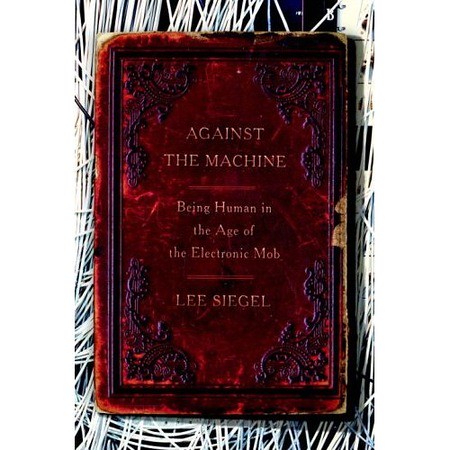
Siegel's Against the Machine: Review

Here is the link to the Goodreads review: https://www.goodreads.com/review/show/742375803

Despite its promising title, Lee Siegel's Against the Machine is less about the struggle to maintain our humanity in the digital age and more about his problem with how the internet age has completely bereft our society of creativity, impartiality, and pure artistic originality. 

My very negative preview of Against the Machine was for the most part confirmed by my reading it.  It is for the most part poorly written, with a few coherent statements and positive suggestions scattered amongst lengthy commentary on how the internet and its promoters have destroyed our culture and anecdotes about how the internet has turned its consumers or "prosumers" into distorted reflections of itself.  He is all about how the internet is people with no talent or originality selling their poor interpretations of things they did not create.  Value in this digital society is determined by popularity, not quality or artistry, and value is also based on marketability rather than detached enjoyment.  Siegel refers a lot to Alvin Toffler's Future Shock (review by my friend Melee here), making references to how we have become more or less the very society that Toffler predicted.  Between the lines of Siegel's ranting is a drawn-out elegy of the death of gatekeeping, regulated print culture, major media outlets and "real" art. 

Adam Thierer, Flickr
  Ironically, although he complains about the bias of our individual-based internet culture, this book is distorted with his own biases, which was disappointing since I chose to read this book based because I thought it promised objectivity.  Perhaps in writing this Siegel is presenting his book as an object lesson about how biased our individualized media is.  If this is the case, Siegel is trying to imbue us with his own negative perception of humanity and modern culture.  He has very little good to say about the internet or the people that use it.  Understandably, Siegel wrote this book to reflect on his very negative experiences with the internet.  So coming from a completely different perspective--where the internet can also be used as a source of good, uplifting content when created by good people for good reasons--Siegel perhaps would not blame me for thinking that he is missing half the picture.

What good points Siegel does make, as I have pointed out, are few and far between, but I will point them out just so we don't lose faith in the author's humanity. He does have a point that he says that the individualization/customization of the internet is not always a good thing.  While it surrounds us with the things we like, however, individualized media insulate us from things we do not like. The internet encourages the glorification of the self and the self's fantasies rather than bringing us closer to understanding other people.  Siegel claims that this contributes to the hate, bigotry, and misunderstanding on political blogs, comments, and other internet posts.  People just say what they want rather than trying to understand the other person's point of view. I do sympathize with Siegel's claim that detachment from people and media as means to an end is disappearing, but I disagree that it is totally lost--or ever will be lost, from society.

 What Siegel could have argued for better, if he argued at all, is a need for limited immersion in the internet culture.  Instead, he just rants about the Internet as a corrupt media, an enhanced societal enslavement and a failed democracy, and a culture that has fallen for corporate capitalism's trap.  He could have at least offered a solution to today's internet culture, if there is so much wrong with it--after all, in the prologue he says "Things really don't have to be the way they are."  So how can they be, Mr. Siegel? Really?

occidentalobserver.net


 I read this book on Kindle for PC.  Against the Machine is divided into three segments with three chapters each. It is fairly short, easy reading. 

Thursday, October 24, 2013

Curation Report--Fan Culture

I have been using multiple tools to curate.  My primary source has been Feedly.  Feedly provides links to news articles and web pages from specific sites.  I have grouped most of my sites into "Fan Culture."  My most useful news sites have been Vulture, Entertainment Weekly, Moviefone, and Vulture.  Today was a particularly busy day on feedly because all of these news sites were posting links to the just-released trailer for Captain America: The Winter Soldier, some with commentary.  For those of you who were just as anxious for this trailer as I:


And not to mention the guy they originally picked to write the new Star Wars movie has been replaced.  With J.J. Abrams and another guy who worked on The Empire Strikes Back.

What I generally do is tag the articles and also add them to Instapaper. After hearing Paul's recommendation in class, I also started using Storify.  This gives me a different perspective on fan culture since I mostly find tweets from the fans themselves.  I am using Storify specifically to monitor Marvel's Agents of S.H.I.E.L.D. show. Twitter and other resources from Storify give me links to news articles and fan reviews.  I spent most of my Storify time today reading the comments to a negative review of S.H.I.E.L.D.--most of the comments were negative, too, but there were a few bold defenders.  Personally I support the show--I acknowledge, it has weaknesses, but I love it.  Mostly because I love Coulson. 

What I need to do with this data is start going to the next step and finding more fan comments about these news developments--especially this Star Wars writer change.  I am also thinking I want to get a Twitter account so I can have more access to tweets and the people tweeting. 

Wednesday, October 23, 2013

Lee Siegel's Against the Machine and the Digital World

Title: Against the Machine: Being Human in the Age of the Electronic Mob.

I want to explore the more human side of digital culture, what media people use, how, why, and how they create, share, and interact in digital worlds. I am told that  Lee Siegel's Against the Machine is about how the internet has changed humanity's minds and culture.  The categories of technology, communications, and commerce are now so intertwined that it is hard to tell where one begins and another ends.  The fact that there are loss of distinctions and challenges to human identity is important to me. What is Siegel's argument and is he right?  How has the digital changed human culture?

Preview:
In the Introuction, Siegel comes right out and identifies a reciprocal relationship between human culture and the internet.  He also identifies himself as a cultural critic with the mantra "Things really don't have to be the way they are."  From what I gather from the rest of the book, Siegel isn't trying so much to debunk myths about internet culture (which he does in some cases) as he is to put the internet in a human context. It is obvious that he's trying to make you think twice about the mainstream, but does he actually propose any viable solutions?  Maybe I saw one while skimming through but didn't realize it was what I was looking for.  Siegel uses a lot of snappy chapter titles and sub-headings and frequent pop culture examples throughout the text--something I think I might enjoy.

Social Proof:
Posted a new discussion on Goodreads exactly three hours ago.  No activity.  Shared update on Google +.  No activity.  Shared Facebook status.  No activity. Guess I should have gone on Twitter after all.

But tonight's episode of Marvel's Agents of S.H.I.E.L.D. had an interesting storyline.  Skye (our hacker heroine) reunites with an ex-boyfriend/fellow hacktivist whose name I think is Miles.  Skye defends Miles from her new friends by saying that he is an idealist who believes in the freedom of ideas...but then her friends find out that he sold information to an evil organization for a million dollars.  Skye is definitely turned off (as she should be) but Miles defends himself by saying that he can't make a living off his beliefs in free expression alone. I recall Siegel discussing the ideas about information democracy in his book.   Not exactly social proof, or maybe it's social proof from Joss Whedon. Maybe I should watch out for copyright wars information and get more info on that.  What is Siegel's position? How does this tie into digital culture?

Friends of Against the Machine.
To Amazon first.   Top results:  Siegel wrote Harvard is Burning and Falling Upwards: Essays in Defense of the Imagination.  This latter option intrigues me. Item added to wish list.  Siegel also wrote Are You Serious?  How to Be True and Get Real in the Age of Silly.  Siegel appears to be an authority on contemporary/digital culture.  His books are linked to books debating the relationship between technology and society.  En route to Google Books I notice that on the search for "against the machine lee siegel" my Google + post from early is number eleven on google search--that's either really good or really bad. The Google books link is right above that, number 10.  The only repeated author on either Amazon or Google is Siegel himself.  Siegel also wrote Not Remotely Controlled, Fires of Love--Waters of Peace, iand Love and the Incredibly Old Man, a novel. His non-fiction books are very culture oriented.

The Social Context
On Google +, it's quality over quantity.  Two years ago, someone shared a video of a TED talk related to the ideas in Siegel's book.  And just over a year ago someone shared to a link of an article by Siegel talking about parenting issues in technology use. 

Twitter Search: No one has talked about this book on twitter since 2011.  The very bottom tweet called it "the first credible book to criticize the digital age."  Found a tumblr link that quotes an email saying Siegel argues that the digital age has turned "privacy into performance, play into commerce, and confused 'self-expression' with art".  Found a link to a very negative amateur review that will be revisited later.  The author himself is very active on Twitter. 

Formal Reviews:
The New York Times 2008 book review reveals that Against the Machine was written in response to a controversy over being "pilloried" by the web because he "respond[ed] to comments about him posted on his blog at The New Republic’s Web site." Ouch.  Am I supposed to expect an angry rant? "Siegel sees the Internet as 'the first social environment to serve the needs of the isolated, elevated, asocial individual.'" That makes sense.  The reviewer points out the fallacy that Siegel neglects the internet culture outside of the US and is overly displeased with Siegel's biased, angry stance.  Lower on the Google search page is a link to a review by the Technology Liberation Front, an organization with a communist color scheme on their website and dedicated to keeping the government off the internet and out of all things technology.  There is a review of Against the Machine individually as well as grouped with other books about optimistic and pessimistic views about the internet, which is also linked to another article about internet optimists and pessimists in general. On this site, Adam Thierer argues that the debate over new technologies and their impact on society is nothing new, in fact it is cyclical.  He divides thinkers into "optimist" and "pessimist" camps.  He argues that the optimists are in the lead but need to be a little less romantic, and that the pessimists need to be less hysterical.  Thierer argues that the preferred approach ought to be "pragmatic optimism."  Thierer catagorizes Siegel as a pessimist along with these titles I have heard before: Andrew Keen's The Cult of the Amateur,  Nick Carr's The Shallows, and Jaron Lanier's You Are Not A Gadget.  Thierer categorizes pessimists as believing that the internet is polarizing, fragmentary, and anti-democratic. Thierer describes Against the Machine as "the dourest of the recent books that have adopted a pessimistic view of the impact the Internet is having on our culture, society, and economy" but also "one of the most important technology policy books of 2008."  According to Thierer, Siegel is concerned about the loss of truth and authority on the internet, views user-generated content with contempt, and that most people want money/recognition from their internet activities.  Thierer accuses Siegel of not looking at the benefits of Web 2.0. Professional reviewers are quoted on Amazon as praising his writing style the most.

Informal Reviews:
First, the Review I found on Twitter:  Sarah D. Bunting on Tomato Nation in 2011. Bunting also takes issue with Siegel's negativity.  Most Goodreads reviews gave Against the Machine a rating of 3 stars or less.  The top reviewer on Goodreads states that Siegel's argument is that the internet is using us and the commercial Web has an agenda to take advantage of us, and the text fails to deliver on the promising title.  Even the most positive reviewer argued that he could have used more positive examples.  Another reviewer says he contradicts himself at times--well, there could be a trickster element to this book, I wouldn't be surprised.  Most Google Books readers gave it a 3 stars or less rating.  The average rating on Amazon is 3.5 stars.  The most helpful review called it "a cautionary tale."  The Amazon reviewers believe this book had a potenitally good idea that failed.  Ouchihuahua.

Can't find anything on Against the Machine in college courses.

Multimedia
I have already found this YouTube video and a Newsweek Article .  Here is an interview  Siegel did with New York Magazine.  It turns out the YouTube video is a TED talk. The speaker said that the internet's algorithms are tailored so that we get personalized search results rather than access to a variety of information, news, and entertainment.  He uses the phrase "internet of one" towards the end of his speech.  The reason I found this video was because the girl who linked it said that Against the Machine predicted it.  While this is true economically, this could also be a model for internet behavior in general.  The Newsweek article is about parental involvement in children's online safety, and includes a video interview with Siegel himself.  The argument is that children's internet activities do need to be monitored by parents, that children are just as vulnerable to online marketing as to online predators, but sometimes parents are also caught unawares in internet activities and put their children at risk.  Unfortunately the video will not play.  As for the interview, Siegel says he wishes people would get over the blog incident that led to his writing the book in the first place.  He says, "I love the Internet, I’m on it all the time. I couldn’t have written the book so quickly without it. But I think that its claims for greater social connectivity are a sham. I don’t think it’s making people more connected than they were before, not at all."  He is not opposed to amateurs but hates how the internet treats all amateurs like professionals.  So perhaps he is not quite as pessimistic as the reviewers think--he's just picky. He is pointing out what he thinks the internet is doing wrong.

1 Hour's Worth of Reading
In the space of an hour, I read chapters 3, 4, and 7.  True to the reviews, Siegel is always going back to how the Internet was made for marketing and how people who "express themselves" online are really just rehashing what someone else has said in order to gain popularity and sell their leisure time.  I would definitely classify Siegel as a pessimist.  He is trying to be objective, but he is constantly returning to the same ideas.  This book is part book review of other works on the internet and modern culture and part tempered rant.  But he does say a few things that I could look into, stuff about the nature of art and remix, and also about the real "freedom" of the internet experience. 

My Thinking So Far:
I wish I'd read something else. Siegel is informative but not objective.  I wanted something a little deeper.  I think I would still like to read this book but I want to find other books with differing or at least tempered viewpoints. 


Monday, October 21, 2013

Fan Culture Bonding Time

So this weekend my Literature of the American West class visited Arches National Park.  While I enjoyed finally being able to check something off my bucket list, I also bonded with my classmates by climbing on the red rock and talking fan culture with my classmates.

Self-portrait in front of Landscape Arch. Personal Photo.

It started about six in the morning when we left Provo.  One of my classmates, Amanda, told the most unbeleivable fan story I have ever heard.  The previous evening her ward threw a Halloween party, and her sister/roommate wanted to be the She-Hulk and go all out--that is, entirely bedeck herself in green laytex paint.  Amanda still had the paint in between her fingernails to prove it, not to mention the paint was all over the bathroom, the floor, etc.  So they go to the party.  Nobody recognizes what character Amanda's sister is--except for a guy who approaches dressed as Captain America (and may I add, fangirls, he also had a similar build to Chris Evans).  They dance, and as it turns out both of them are Latin dancers.  At the end of the night they exchange names and phone numbers.  Deciding not to take any chances, Amanda and her sister go home and facebook stalk the guy in case he's a creeper.  As it turns out, he is not. And not to mention, in spite of the Marvel-themed costumes at the masquerade she discovers that they both like the Justice League. 

Now be honest: how many of us singles have common fandoms as requirements for potential spouses?  And how many married people are with their current spouse because they had a fandom in common, among other things?  My parents, for instance, both like Star Trek, Star Wars, and Indiana Jones. 

Navajo Arch, personal photo

And of course, friendships are often fueled and enriched by fandoms. I spent a good part of Saturday talking and hiking with Amanda, and although we were able to relate on a number of different subjects, it was the initial interest in our common taste in superheroes that allowed us to bond during the day. 

The last area of the park we visited that day was the Windows area.  Although quite an interesting area in its own right, one of the reasons we stopped there was because the opening sequence of Indiana Jones and the Last Crusade was filmed here.  I have never liked Indiana Jones, despite my parents' efforts to breed me to the contrary, but I have seen most of the Last Crusade and Raiders of the Lost Ark.  But my classmates were a little more enthusiastic.  I just tagged along because I wanted to see Double Arch.  While walking over, one of the class' pop culture gurus, Andrew, whom Amanda and I had also been hanging out with, put on a bandana and turned it backwards to imitate young Indy as a boy scout.  So to Andrew and the other Indy fans, the Windows Area was a pilgrimage to an area connected to a fan culture they were part of. 

Double Arch. Wikipedia Commons.

In much the same respect, a Star Wars fan like myself would want to visit Tikal, Guatemala where A New Hope was filmed, because ever since I saw that movie for the first time as a little girl my mother has been telling me that that place is in Guatemala (I would also like to visit Tunisia but unfortunately the movie sets there are buried!). Fan culture is an imaginative way of viewing the world, and visiting movie backdrops is a way of connecting to the physical reality of that imaginary world--these are physical places that have been manipulated by the human imagination to have a whole new meaning, rather the same way religious sites become places of pilgrimage.  So that's where the anthropology of fandoms and the digital universe becomes apparent.

Thursday, October 17, 2013

Post-Midterm Mapping

No thanks to the time crunch last week, my paper didn't turn out as good as I would have liked it to, but my topic of immersion really caught Dr. Burton's interest.  In all honesty, I wrote about immersion because that was the topic that caught my interest.

 I would like to continue exploring the topic of immersion, partly to articulate my ideas the way I would have liked to in the paper and partly to see if there is actually evidence to support my claims.  I want to focus specifically on immersion in fan culture.  I think Dr. Burton got my number during the interview when he asked me to describe a digital subculture.  Fan culture is the subculture I am most familiar with and most deeply immersed in myself.  I like being a fan of popular sci-fi and fantasy brands because they give me something in common with other people, even if my tastes aren't quite as conventional as other fans'.  I feel like this is a topic that would give me an excuse for answering my own questions about fandoms and also exploring how fan cultures behave as, well, cultures, and how do people behave or immerse themselves within these groups or within the imaginary worlds they have in common.

I feel like since working on the paper that using the term "culture" has been a reminder that I am an anthropology minor.  In an anthro class I once took the professor once asked me what English has to do with anthropology?  Well, everything.  Language and literature are what make us human.  Referring to Dr. Wickman's lecture on Wednesday, the humanities exist to help us think and engage, and people who are immersed in fan cultures think and engage in specific ways because their worldviews are informed by certain media.  In a telephone conversation I had with my dad earlier today, he commented on my ideas about war and peace, justice and right and wrong, etc in the draft of a fantasy novel I am working on.  I told him that I got my deep ideas on these subjects from reading the Redwall and Harry Potter books as a teenager.  Within a fandom, fans engage with certain media that, via their immersion, give them reasons to think deeply about certain issues. 

I am also encouraged to go in this direction because I have other classmates discussing these issues, specifically Kylee, who wants to discuss fan fiction, and Mary, who is curating material on the Sapir-Whorf hypothesis.  This is going to be exciting!

Monday, October 14, 2013

Meme Contagion


So when Dr. Burton introduced me to The Information by James Glieck I found a new way to look at how ideas are shared--especially in the sense of memes. The original term "meme" has nothing to do with the quirky captioned pictures that we enjoy today.  Gleick re-envisions the world of ideas or human culture as an "ideosphere" coexisting alongside the biosphere where all organic life exists. And like life, ideas have a life of their own, and they grow, spread, and multiply like other life forms. 


As early as 1976, scientist Richard Dawkins proposed the term meme to define the "bodiless replicator" of ideas, similar to the term gene.  Within human culture, memes are transmitted between human brains through language and then within the brain are reconfigured (or mutated) and re-emerge as new, bigger ideas. Categories of memes or "meme pools" include ideas, tunes, images, and catchphrases. 

One of the most popular catchphrase/image memes of the last year or so is the "Keep Calm and Carry On" poster.  Recently, I was wondering where exactly that poster came from, and thankfully a little while ago I found a video link floating around on Facebook.  The story is actually very inspiring.


As we know, the original poster has been turned into several spin-off memes that you have probably seen on Facebook or other sites.  For instance:


Donna Brown on flickr.

The idea that is mutating here is to create a poster with a reminder to give us a reminder and encourage a certain action that will help us to succeed. And aside from being very entertaining, some of these knock-offs are inspiring in their own right.

LeventKayin on Keep-Calm-O-Matic.uk


As some of you may or may not want to remember, one of last year's top songs, Carly Rae Jeppson's "Call Me Maybe" is an excellent example of a musical meme.  It has inspired spin-off songs as well as knock-off memes mocking the concept of you are telling something crazy to someone you just met, for instance that you would like them to contact you or do something else out of the ordinary.  And of course, some of your opening blogs were entitled "Call me [insert name here]".  the association with the song makes it catchy and attractive.

So what do memes have to say about my theme topic of immersion?  Memes are the substance of ideas that is shared between people.  The propagation of certain memes is a sign of engagement in the related topic.  Within a fandom, for instance, memes are bridge connections between a popular/very mocked song and a particular movie/film.  When this connection is shared, the meme is recognized, accepted, and propogated by members of the fandom who recognize the connect--especially if it's funny.  I think funny memes are particularly "viral" because we're always on the lookout for something funny.

So that's just one chapter of The Information--the memes we are familiar with are manifestations of memes that we share every day about school, work, and hobbies. Although, glancing through The Information for that one chapter on memes was a headache (it took me a minute to realize I ought to check the table of contents), it would be very informative to read what Gleick has to say about the structure of ideas and our connections to them. .

Thursday, October 10, 2013

A Show for the Digital Age

In a previous post, you may seen a mention Marvel's new live-action show on ABC, "Agents of S.H.I.E.L.D."  I have seen three episodes of the show thus far, and not only do I like it but I am also noticing certain elements of the show that tie in nicely to our course.

The Marvel films produced in the past decade--especially the Iron Man films--have featured very tech-saavy characters who use amazing gadgets and can access unlimited information and communication at the push of a button.  But I draw your attention to S.H.I.E.L.D. specifically because it is currently ongoing.  ABC just approved the show for the duration of this fall season and who knows how many more seasons it will have.  As it comes out, king-of-all-things-nerdy Joss Whedon, who directed the pilot episode and will be contributing to other episodes, announced that it will have tie-ins to the other upcoming Marvel films as they are released.  It will be interesting to see whether or not he also ties in trends of modern digital culture as they come out, since he already has.

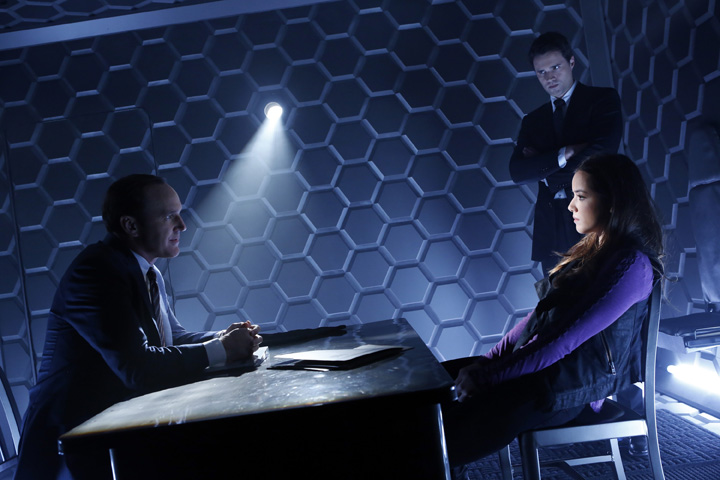
Disney ABC Television Group: Skye's interrogation in the pilot episode.

Don't get me wrong, I love Coulson (he's the only character I'm really attached to), but the character that digital media fans should pay attention to is Skye.  Skye is a self-proclaimed "hacktivist."  We have mentioned this term under digital subcultures but not in depth, so allow me to do an Ishmael and define briefly.

The word hacktivists, you English majors may have guessed, is a hybrid of the terms "hacker" and "activist."  A hacker is someone who hacks computers, an activist is someone who pursues a political cause. A hacktivist, then, seems like someone who is an activist who promotes his or her cause by hacking computers and digital accounts.  One website defines hacktivism as "act of hacking, or breaking into a computer system, for a politically or socially motivated purpose."  Mashable.com "the use of computers and computer networks as a means of protest to promote political ends" and also features a grandiose infographic about the history of hacktivism.  To cite a couple of examples from this infographic, hactivists range from government-sponsored hackers (employed as recently as the war in Syria to keep tabs on certain parties) to underground hackers you may be more inclined to envision when the term comes to mind. Hactivists present a challenge to authority in a sphere--the digital--that governments and other agencies have only limited control over.

courtesy of marsmet tallahassee on flickr


Skye in Marvel's "Agents of S.H.I.E.L.D" falls in the latter category of hacktivists. She is a member of a very sketchy organization called "The Rising Tide" that opposes S.H.I.E.L.D's and other organizations' attempts to hide the truth about top-secret and supernatural events in the world, and she is very vocal about these views in the show.  She is also extremely technologically-savvy, and as a character she is very careful about tying herself to certain sides of a conflict.

In the first episode, Skye is found working independently from a van rennovated to be a communication center, recording messages about how S.H.I.E.L.D. is covering up the truth and how the Rising Tide will thwart them.  S.H.I.E.L.D., inevitably, tracks her down and arrests her for information in a case they are working on, and during her interrogation she boasts that she hacked into their "billions of dollars of equipment" with a laptop she "won in a bet." The line is funny because it's ironic, but it's also true.  In our class as well as in Johnny Evers' lecture about creativity, we have seen examples where enthusiasts and fanatics have outperformed government and commercial research agencies in creating and deploying working technologies such as drones and space probes.  According to Evers' lecture, it was not Steve Jobs who changed the world by himself, but Steve Jobs and a bunch of other obsessed fanatics who worked with him who changed the world.
Disney/ABC Television on Flickr. Left to Right: Skye, Simmons, Fitz, Coulson, May, and Ward


Coulson is impressed by Skye's talents, and he sees her as an "asset" and invites her to join his team of S.H.I.E.L.D. agents on their special missions to "protect the world from the weirder world"--an idea opposed to Skye's values, but Skye surprisingly accepts the offer.  None of my friends who are watching the show with me are sure she's entirely trustworthy, but from what I have seen she is using her digital skills to prove herself.  In the second episode, Skye lectures one of the other agents, Ward, about the value of collaboration, and this idea helps the team get out of a literally tight situation.  At the end of the episode, when Coulson asks who idea it was to do such-and-such to save the day, one of the agents says, "it was everyone's idea."  Skye values collaboration because as a hacktivist--someone who knows both computers and political causes--she knows it works in the digital world.  As we very well know, in a movement known as the "Arab Spring" that began a few years ago, several middle eastern governments were toppled by people who banded together through social media and staged successful protests. As Dr. Burton said in our collaboration lecture, it is "no small thing if you can overturn an entire nation with your thumbs."  To quote Skye, "1 person may not have 100% of the solution, but 100 people are more likely to have it."  When people come together through the internet and share their ideas, they learn and solve problems in ways they could not have on their own or in offline company. 

And then in this week's episode, Skye's help was needed in a break-in.  The S.H.I.E.L.D. team was going to Malta to rescue a S.H.I.E.L.D. "asset", but could not land a full break-in squad legally due to international law.  Skye, since she is not yet technically an agent, decides she will go into the manor of the villain billionaire on behalf of the team to help Coulson and Ward break in from the outside.  True to form, she garners an e-vite to a gala at the mansion being held the day of the break-in--and may I add that she did this on her phone while the team is arguing about whether or not she should go--and she introduces herself to the billionaire as a "hactivist."  So from what I have observed of Skye thus far, a hacktivist knows the ins and outs of private and organizational accounts and not only hacks but manipulates the system to get what she wants and make a statement.  Our technology may not be as up-to-speed as it is in the Marvel Universe--touchscreen computer tables, communication earbuds, and instant data access--but it is interesting to see crossovers between that world and ours.

Classmates: I am having friends come over to my apartment to watch the show on Tuesday nights, and if you want to come over let me know!  Marvels "Agents of S.H.I.E.L.D." is on ABC Tuesday nights at 7 local time, or you can watch episodes here: Watch ABC

Monday, October 7, 2013

Conference Counsel

After reviewing my notes from the Sunday sessions, I came across the talk given by Elder Kevin S Hamilton of the Seventy from the afternoon session. He gave some specific counsel relevant to internet use and digital media.
  • Good, Better, Best: Good activities are too often substitutes for better and best.  Satan can cheat us by having us focus too much on a good thing and ignoring the better and best. While he was specifically referring to online hobbies such as social media and games, I also see a way that his counsel can be applied not just to what we do on the internet but how we use the internet's resources.  Do we spend our time liking other people's statuses and entertainment posts without contributing material of our own--this is not just spiritual stuff, but also secular posts as well--that can uplift others and contribute to online discussions?  Do we use social networking to literally "network" in order to connect with other people and resources to find specific information and share ideas, as we would if we were doing a research project? In other words, are we optimizing the resources at our disposal for the benefit of others, or do we take these resources for granted? 
  • Simple Decisions have Eternal Consequences:  This applies very much to decisions we make online as well as offline, including how we spend our time, what media we use and how, and what materials we share.  Why has the Church invested so much into online proselyting?  Because offline, it is often simple conversations or events that lead to people finding the Gospel and joining the Church, or in some cases becoming active again after a period of inactivity.  Likewise, with online proselyting, missionary work doesn't have to take a lengthy online chat session to convince someone to meet with the elders in person. It can be as simple as a tweet, text, status, or a shared link, video, or picture. You don't even have to be doing it intentionally!  As Dr. Burton mentioned in class today, sharing Gospel-oriented materials on social media sites can be as easy as sharing a post about watching conference in your pajamas to get the attention of someone outside the church--because it has your personal stamp on it and not the mark of the corporate Church. If the people who are seeing your status are your friends, they will recognize something you post easier than something blasted all over the net by a strange religious organization.  In the Saturday Session, Elder Arnulfo Valenzuela quoted Alma 37: 6-7. In the context of Elder Hamilton's address, this scripture has a double meaning: the simple things we do each day either draw us to Christ or pull us away from him.  Likewise, the small things we do to share our testimonies online--or to find answers to our own questions--can make a huge impact on the people who observe our example. 
 And here is a meme: conference is not complete without the memes, right?


Saturday, October 5, 2013

Midterm #2

So, this will just be brainstorming. I will be using this blog post for my personal reference as well as your enjoyment.  If you have any ideas or suggestions be sure to comment.

My defining questions are: 1) How does one define immersion, especially in the context of both Moby-Dick and digital culture? 2) How does one become immersed in the digital world?
Immersion is about belief in what you really think is out there versus what is actually there.
The first instance in the book that comes to mind is on page 278: Ishmael's observation that a sinking whale corpse is regarded in logs of merchantmen as shoals and rocks that ought to be avoided.  He also observes that this is how people in general tend to think.

Being LDS, when we think of the word immersion, we think of baptism.  However, in Moby-Dick and in the digital world, rather than coming up from something, immersion in this means going into something and becoming part of it. For instance, on page 435- Ahab "baptizes" his harpoon in the blood of pagans, in the name of the devil. This may be equated to his assuming an avatar or identity--What identity do we immerse ourselves in in the digital world? Do we represent ourselves or adopt a "persona"?
This Smithsonian article  suggested by Dr. Burton leads me to a book about information technology, life,a nd ideas, called The Information: A History, A Theory, A Flood, by James Gleick. I will look for this at the library. The ideas in this article go back to  page 278 and the orthodoxy quote. And as a side note,
this is why the LDS Church has a centralized hierarchy, manuals, and web tools so that all of the members get the same message and to prevent the ideas about the gospel from being perpetuated incorrectly. 
So this is my working thesis statement and a rough outline of the ideas I want to write about: 

To Ishmael, there is an entire ocean of ideas and knowledge to follow and explore, but Ahab's downfall come from refusing to open himself to this diversity (better word?) and immersing himself in the narrow idea that he must take revenge on the White Whale. 
  •  There is an entire ocean of ideas and knowledge to follow and explore
    • the digital universe exposes us to this
      •  creating online profiles and avatars
        • Ishmael signing the ship's articles? (62) 
        • by signing up for a service you allow messages and updates to be communicated to you--you join a larger world when joining the internet; but, in reverse, Ishmael was joining a smaller world.
      • by interacting with others online
      • by "going places" within the digital world
    • Ishmael spends the course of Moby-Dick trying to comprehend the vastness of the ocean and the manifold aspects of whale science and whaling; 
    • he immerses himself in the avatar of the Adventurous Sailor "Ishmael" the outcast, the one who wanders around and in wandering, explores and sees many things
    • Immersion as place: he wants to go everywhere and see everything
    • Immersion as belief:  he knows the danger of limiting ideas; he knows the benefits of knowing what's out there. (page 1--when he gets stuck in a rut on shore it's time to go to sea for a change of scenery)
    • you can't stick yourself to one idea because that's the nature of ideas: they aren't always what they seem!  like genes, ideas (scientifically labeled memes) want to spread and change (this was in the Smithsonian article).  Ideas are never stable, they change as they are transmitted, so one idea shared by one person can be altered by someone else and completely misunderstood as it is continually shared.  What Ishmael knows to be a whale's corpse is a reef to a merchant ship that runs across it.
  • There are dangers in becoming limited to a single idea
    • there are multiple instances in the book where he is described as standing in a pivot-hole on his peg leg: the peg leg IS his monomania, it is his rut, it is his revenge
  • Ahab immerses himself to the narrow idea of revenge, separating himself from the wonders of the ocean and the happiness he could have had in the world at large 
    •  identifies/immerses himself only with his lust for revenge (monomaniac)
    • not to make a living off the sea and all of its treasures, but to hunt for the one thing he wants and ignore the rest, including the danger (find book quotes about this)
    • Immersion as place--Ahab is only ever in one place, in one perspective
    • Immersion as belief: he wants to kill the whale, he thinks if he kills the white whale he will have revenge and revenge will bring him....? The satisfaction of getting even. This isn't even getting even, because whales don't have legs.
This is the research I want to do:
Comb Moby-Dick for more quotes. 
Check out the Gleick book: I might not read all of it but there might be an introduction or something similar to the Smithsonian article.
Check what other people have said about online avatars and immersion; start with my other crewmates on Moby Digital and then check elsewhere on the internet.
Find scholarly articles about immersion into certain aspects of reality or virtual reality and perhaps immersion into avatars; perhaps I may find an article or two from a psychology perspective, or maybe find a book about the psychology/sociology/anthropology of identity.

Friday, October 4, 2013

Midterm #1

My posts for the course so far:

 Hi. I'm Lizy
My introductory blog post.
What's In a Tail?
 Immersion in print versus online.
Me and my Memes
 Memes
I'd Like an Excuse to Post More Memes
 The significance of Memes--Dr. Burton suggested I look into that further. I think I might find a way to tie in memes to my final project. Memes can be very specific to people who are immersed in certain fandoms/cultural groups and have read certain texts.
 Worth Whaling About?
 Real whales, whaling, and our attitude towards the environment. Also posing the question, Is it true that all the information you can find in a book can be more easily found online? Is the reverse true?
The Two-Edged Sword
 The benefits and drawbacks of the use of social media, as evidenced in a Case Study
Another Success Story 
 How fans of Stephanie Nielson's blog reached out to her in a time of need.
Seeing the Good
 Changing my views on the purpose of video games.
 Lizy's Affidavit
Or, proof that Dr. Burton's theory about social proof actually works.
Post-Moby Stress Disorder
Questions about the cultural significance of Moby-Dick and the significance of the white whale. Also, questions about how deeply immersed I am in the story.

I'm seeing a theme of immersion emerging here. I'm not very engaged with digital culture in general, but I am interested in how individuals and societies become immersed in print culture, digital culture, and other media.  Thanks to the information available on the internet, people can become immersed in any topic they chose and discover how to research and recreate their interests.  Not only that, they can use the internet to reach out to other people with similar interests and collaborate in creating larger projects and in gathering to discuss their issues in person.  Significantly, we see this trend occuring in fandoms at events such as comic-cons.

So how deeply can one become immersed in an interest? How does this immersion manifest itself for individuals, in public and across the internet? And how does this affect perception of reality? Is the internet a part of reality, or is it a different reality altogether? Are video games a reality? Books? Physically, yes, these things take up space, but like the TARDIS in Dr. Who they are much, much bigger on the inside than they are on the outside (disclaimer: for the record, I'm not officialy a Dr Who fan, but I have enough Whovian friends to know what I'm talking about when I make this allusion). As technology gets smaller, conversely the world gets bigger. How is this possible? Is this a reflection of how the human mind works?

And considering the similarity to my questions and those being asked by Greg about the depths of reality and virtual reality, I do think I ought to consider collaborating with him. 


Thursday, October 3, 2013

Post-Moby Stress Disorder

So I may definitely be having post-Moby Stress disorder (PMDSD).  I had a nightmare last night in which I was at this large resort on the west coast  that had piers going miles out to sea so people could watch whales up close, and they were very real-looking whales... but all of the sperm whales I saw were white and trying to kill the humans.  It's as if Moby-Dick had an enormous posterity, and somehow they all came out white. And I was scared.  And the people who owned the pier wanted to capture me and my family and turn us into animals to keep at a zoo.  I managed to stop it when I punched my mother in the back three times, and then I woke up.

So I didn't know liking Moby-Dick too much could do that to you.  Either that or I've been having too much fun playing the video game.

And my Western lit class today didn't help.  We were talking about Edward Abbey's Desert Solitaire and Dr. Snyder and one of my classmates kept comparing Abbey's writing to Melville's.  So asked them "Will you please STOP! I had a nightmare about white whales last night."

Dr. Snyder's response: "As you should."


What? Moby-Dick is supposed to haunt my dreams? 

But this invasion of my subconscious has me thinking. Cheri's post about the persistent popularity of Moby-Dick recounts how in popular culture, while not many people have read the book the story of a revenge-bent captain hunting a white whale is still well-known. I think I want to take her question to heart: what is it about Moby-Dick that has made it enduring?  And what about it makes it pervade the popular consciousness?

Allow me to explain myself: I am a fangirl of Moby-Dick not only because it is awesome but because it's Moby-Dick:  it's the 1000-page book that nobody reads.  But last weekend I finished reading it, and I consider it an accomplishment. There is definitely an aspect to Moby-Dick that, given its reputation, that makes it interesting to have a connection to.   I want to call it "quaint," but I think that would be too weak of a word.  Maybe "peculiar." No, it's "bizzare." It's out of the ordinary.  Perhaps there was something in the original story that would characterize it as bizzare: Captain Ahab with his obsession and his peg-leg; Queequeg, Stubb, the other random happenings aboard the Pequod.  And not to mention it's very nautical. What can I say? It's full of awesome. Why not celebrate! It's a big, loose fish in a sea of a culture that celebrates and values spontaneity.


But if one is so proud of having read such a ginormous book, then what else should be haunting about Moby-Dick? 

One question that bothers me is, why is the whale such a huge part of the pariphanelia if we know the whale is responsible for the deaths of multiple people in the book? It's like wearing a cross. Are we taunting Moby? Or does the whale stand for something in popular culture? Like an elusive dream?

Does it haunt us because we all have white whales we are chasing? I'm not chasing anything...ok if I said that I would totally be lying. But I'm not Ahab, seriously. I don't think the dream was an omen.

Ishmael, for one, definitely comes out of his experience with a deep reverence for the White Whale, as well as perhaps a fear of it. A whiteness that he equates with death and decay; the barbs and broken harpoons of sailors it has outswam and destroyed.

What was it in my dream last night that haunted me?  The whales were after me and my family, they were going to eat me, and they were HUGE, like, I could tell in the dream they were life-sized.  And  they were white like Moby-Dick, a whiteness that perhaps my subconscious equated with my own death.

Questions this makes me ask:
What is the influence of Moby-Dick in pop culture? What does this say about how pop culture works?
How does the way people summarize Moby-Dick work in real life? What is the connection between compressed perceptions and reality?  How does this type of thinking work?

Wednesday, October 2, 2013

Lizy's Affidavit

Dr. Burton's chapter in  "Writing about the Humanities in the Digital Age" is his manifesto.  I was kind of relieved to learn that even he had his misgivings when he began having his students write blogs.   I don't blame him in the slightest.  But his arguments, when he made them, were made with a lot of courage.

I have never seen myself as a tech-savvy person.  I never wanted to be one.  However, this is impossible because I live in an age when it is impossible to disconnect oneself entirely from the internet and computers.  Not only is technology more convenient, it has gotten to the point where disconnecting oneself from these technologies means disconnecting oneself from everyone else.

And I always thought this was tragic because I believed that texting, social media, and internet pastimes were bad because my parents didn't use them. Well, bad might be too strong a word, but unneccesary.

But, when I was in Dr. Burton's Shakespeare class this winter, I opened up not only because blogging and social media use was required for my class, but because by using these tools I learned that digital communications can BE a tool that can benefit an individual's academic studies.  Like a whaling ship's tackles and hooks can be used to open up a whale and harvest its valuable blubber and oil, the internet can be a tool to harness, pry open, and harvest information about a research topic.  It made the digital age not only easier to accept, but welcome.  I realized that the internet is not just advertizing and social forays--it's a TOOL.

The difficult part about Dr. Burton's Shakespeare class was gathering social proof.  Somehow I never got around to talking about my research paper with my Medieval Club friends, my coworkers didn't understand what I was talking about in the first place when I wanted to talk Shakespeare, and I was also extremely anti-social because I never saw anybody outside of work and club and school and my best friend had left on a mission and left a cold, drizzly November in my soul from January to March.  However, I did take Dr. Burton's advice about posting my thesis statement and paper outline on Facebook, and it paid off big when I went to my grandpa's funeral in March and I was able to talk in person about my paper with a cousin who had followed my paper updates on Facebook, and that turned into a good bonding experience for us (oh, and by the way, that cousin is expecting a baby now).  So what it amounted to in the end was the right communication tools, perseverance, and my grandfather's timely passing. And that's why crowdsourcing and social proof is important, because you just NEVER KNOW when someone has the right answer for you.

And moreover, tonight on Marvel's Agents of S.H.I.E.L.D., this topic actually came up:  no one person has 100% of the solution, but 100 people do.

Postscript
Themes I am discovering: digital technology as a tool; long tail of crowdsourcing/social proof; changing opinions

Monday, September 30, 2013

Seeing the Good

Undoubtedly, I am one of the people that Dr. Burton saw at the guest lecture on Friday--because I saw him there. And the second half of the presentation totally validated my ambition to be a fantasy writer--creativity is one of my strengths, and I plan on putting it to good use.

However, the lecture also brought up the topic of video games and why they can be beneficial, even necessary. I never thought that being morally and individually opposed to video games would be considered a weakness. 

I think if I explained my background a little bit, then my perception on video games would make sense.  Both of my parents grew up before video games were invented, and when they first came out they were both too busy trying to take care of themselves--they were both single for a long time--to be bothered by them.  And my dad, especially, grew up in the mountains of north-central Arizona, where even access to television was very limited, so he has always tried to restrict my siblings' media use growing up, but to little avail. That being said, I understand my dad's initial aversion to video games. 

I played a handful of computer games and almost no video games growing up. When my younger siblings started taking music lessons, Dad had to give them incentive to practice their instruments, so he offered to let them play Y amount of minutes of any given computer game for X amount of practice time.  For the first few years it worked rather well.  But with every game interest would wane as they played through, then they would stop practicing, and then Mom and Dad would have to buy a new computer game to give them more incentive.  I would watch them playing for a few minutes but always told myself I had "more important" things to do.  I would also notice when Dad and my youngest brother got into a fight every time my brother lied about going over his computer time, and that only made me more averse to gaming. 

And the media wasn't very helpful at all, because I always heard stories about how people who played violent video games turned into criminals and how leading virtual second lives took away from enjoying reality and taking care of oneself.  I have spent my entire life looking down on people who play video games--including, I am ashamed to say, my closest friends.


Friday's lecture with Johnny Evers completely shook that image.  I had no idea that video games could teach you social skills and management skills and offer you a safe way to practice life.  Now I wish I'd known about games like "Civilization" that help you not only to build virtual worlds but teach you to manage them with money and decision-making.  Heck, if I want to be a fantasy writer, isn't that the sort of thing I'm supposed to be practicing?  Wouldn't that have been more useful than minoring in Anthropology?

And far from creating socially backward people, video games, Evers argued, improve social skills.  To think that if I had played social video games growing up that would have been a much better approach to navigating high school than curling up in the corner and reading when people started picking on me! And a year and a half ago I was struggling with depression--if only I had known about that game "Super Better" when I was trying to get through that! If there was any validity to Evers' claims, then I am really missing out.

I realize that a lot of these things are true only to a certain extent.  I am not blinding myself to the bad things about video games, they're still out there, but for the first time in my life I was opened up to the good.

So in that spirit, I decided to swallow my pride and try out the Moby Dick video game.  It was fun, but challenging. Does that game provide instruction in important life skills?  How about multi-tasking?


Thursday, September 26, 2013

Another Success Story (A Response to Kelsey)

This post is sort of a response to Kelsey's post about online success stories.

The more I learn about how digital culture works the more I realize that my use of it is going to impact my endeavors. Dr. Burton's lecture two weeks ago about crowdsourcing opened up the possibilities for me. The Compose site sounds really interesting because I have one or two ideas for musical scores for fantasy stories, but I don't know the first thing about composition. More importantly, inviting an audience to critique something, like an excerpt from a potential story, is  a good way to edit a story before/without going through an editor. And, most importantly, using social media and free online excerpts is, I have it on good authority from other authors, a good way to build a fan base.  (Sigh) My only excuse for not working on my fan base right now is I'm trying to finish my education.  But I'm starting to see how it all fits together.

A fan base to an author that not only contributes to his/her work but helps promote it to the public is, because of the internet, capable of doing things that an individual writer could never do alone for himself/herself, for instance, preventing piracy of  copyrighted material.  Sometimes, there are incentives for their support such as free autographed book copies or other such trinkets.

However, for the fans of Stephanie Nielsen, the only incentive was wanting to do something good for someone who inspired them.

I used to see Stephanie Nielsen around BYU Campus sometimes my freshman year.  Then I recognized her in the following Mormon Message:


That was how I learned her story.  Then about a year ago, her book Heaven is Here came out.  I read it this summer, and I would be quoting from it directly had I not loaned it to my grandmother.  Yes, it is a memoir, and Stephanie might be considered an amateur, but it is one of the most intense books I have ever read, it is very well-written and has some mystefying spiritual and literary elements.  I have an aunt who read it who said she was crying every three pages.

So, to summarize: Stephanie is a Provo native who always wanted to be a stay-at-home mom. When her family moved to New Jersey--at a time when the blogosphere was just emerging--she began a blog to keep up with her family back wes, the The Nie Nie Dialouges. Her blogs is quite interesting, really: the writing on  is more like loose free verse than prose. Her blog became a DIY/ homemaking/ mothering/Mormon living blog, and began to attract a fan base.

Then, in August 2008, she and her husband were in a plane crash outside of St. Johns, Arizona. Both were terribly burned, and Stephanie was in a coma for the next three months.  When she woke up, her family informed her that her blog fans--thousands of people from across the country--had banded together to raise money to finance her hospital stay: I don't recall the exact details but there were charity concerts and benefit dinners, at least.  (Please correct me if I'm wrong, please check the comments below if someone corrects me). It was pretty impressive. And it was all because they liked her blog, they were touched by her words and her expression of faith, and they wanted to do something for her.

So ever since, Stephanie's blog has documented her journey to recovery and her gradual return to a normal life. She also continues the DIY portion and posts frequently about her material interests, the causes that she supports, and her family life. She always posts links to other websites where her readers can get more information about other people's stories and products, her other projects, and the church website.

In a recent blog post calling out for support for children with cancer, she wrote the following:
"I know the amazing outreach the blogosphere and internet has!!
My family and I have been tremendously blessed by it.
I know we can do the same for this family and others who 
are in the same situation!"
... If you want to tie this in to Moby-Dick, then I will. Stephanie's blogging for support for other people in need reminds me of Ishmael's visit to the church in New Bedford where he sees all the memorials to missing sailors. And in another chapter, he makes the following dire statement on behalf of his fellow whalers:
"For God's sake, be economical with your lamps and candles! not a gallon you burn, but at least one drop of man's blood was spilled for it." 
Moby-Dick could be called Melville's/Ishmael's "blog" or website for the awareness of the perils of whaling and the perils of life in general.  Unfortunately, Melville never found a fan base in his life time, and people didn't realize what he was saying until it was too late. So the key to a successful "blog", book, or anything, is making sure that other people can connect with it.