I think I would make this post an answer to Dr. Burton's call for
explorers. In reading
Moby-Dick you get a lot of descriptions and ideas that you can't quite visualize. So in going beyond the text to sources online and in print, I am exploring the world of the novel--not only the hard science behind it, but how the different knowledge between then and now represents the changes in technology and culture. This is a long post, but I am going to put in pictures for your amusement.
So today I went to the library. I found the section on whales on the second floor. Their most recent books are from 2011. I thought about checking out one or two or them, but I was pressed for time and didn't know how to make up my mind. And there's also the myth/idea that any knowledge that can be found in a book can also be found online. I want to compare Melville's knowledge of whales with stuff about whales you can find in books versus information online. But I'm not sure how that would work out. Mostly, I want to be able to illustrate whaling and whales in general to for the book, both visual and textual.
I decided to try a bookshelf since I like books with big, color, captioned images that I can put my hands on. It's the good old-fashioned way. There weren't very many of those kinds of books at the library, though. So in lieu of an actual book, I will use online sources for this post and perhaps try and come back later to see what the books say in comparison.
I would like to start with the Cetology chapter, since we don't know exactly what kinds of whales he is referring to. Since Melville's original readers would not have had as much access to books and television to tell them about the sea, he gave a lot of description so his readers could have that experience.
However, cetology today is competely different from cetology in the mid-19th century. My object of exploration is to see what has changed, and how. For my online sources, my two main sources are Wikipedia articles on
the chapter (Chapter 32) and on
ceteans.
For one thing, whale classification. Ishmael organizes whales completely by size (remember, this is about printing, not whaling). Whales today are classified by physical characteristics and (theorized) evolutionary relationships--Darwin's
On the Origin of Species, which would revolutionize the biological sciences, was not published until eight years after
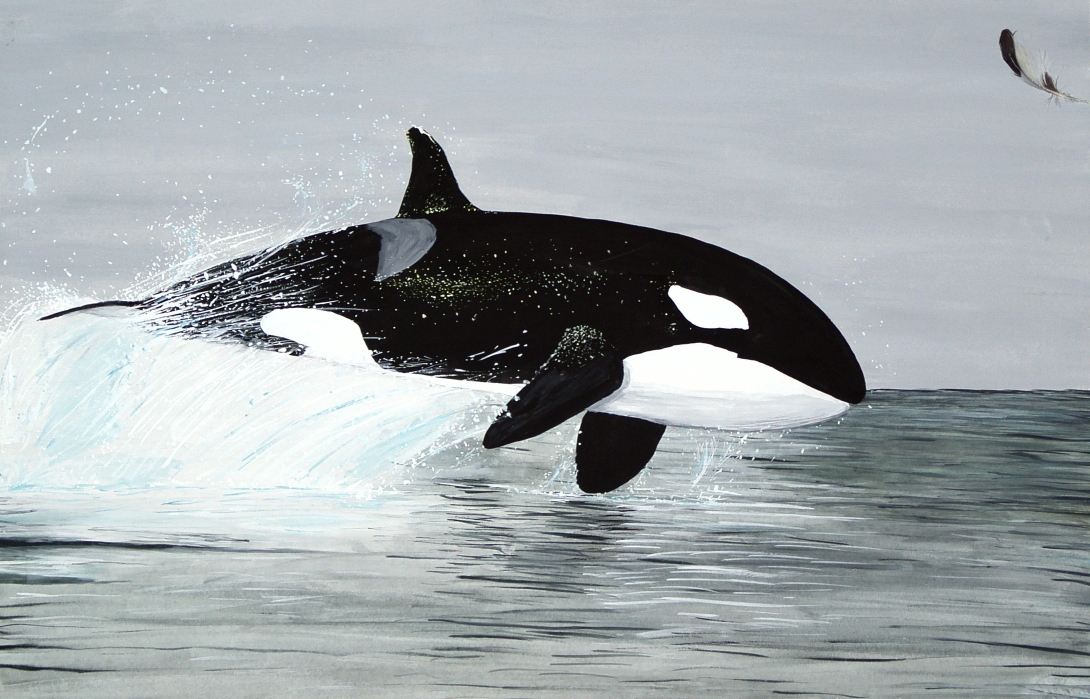
Moby-Dick. Ishmael takes "the good old-fashioned ground that the whale is a fish, and call upon holy Jonah to back me" (Mellville 118). Without scientific inquiry about the whale, Ishmael relies on the sacred reputation of the Bible. As for the whales themselves, according to the Wikipedia article the "Razor-Backed" and "Fin-backed" whales are the same, and the "grampus," "Killer whale," and "thrasher whale" are all the same species, the killer whale or orca. The "black fish whale" is the pilot whale and the "huzzah porpise" is the bottle-nosed dolphin (no surprises there).
And for anyone who wants it, here is a link to a
plaything that an animation major friend of mine showed me: I wish it did more tricks.
The "Sulphur-bottomed whale" is the Blue whale. One of the more surprising things about 19th-century whaling is that there is no mention of the Blue whale at all, and the sperm whale is regarded as the largest whale. (Quick Rant: I hate that I have to go back to Wikipedia, but it's the only source that's coming up with the information I want. However, I was able to find another source on the origin of the
name "Sulphur-bottom") The Blue Whale was not better known until 1874 when the name was coined, ironically, by a whaler (but Ishmael says whalers make the best explorers). As for when the blue whale was officially recognized as the world's largest creature (and not the Sperm whale), I am having a hard time finding that information. Ishmael's cetology guide is incomplete, and he himself acknowledges that not all of the whales he knows about, even the ones he has classified for us, are known completely.
Secondly, the sperm whale itself.
I have always considered sperm whales to be very ugly. A big head, a long narrow snout, narrow jaw, usually gray or brown in color, small eyes, and bad reputation (which Melville probably did anything but help in writing
Moby-Dick.) But they are pretty cool.
(whaleindex. com)
Their brains, which Ishmael describes as an edible delicacy (Melville 270), are the largest brains of any creature on earth, according to multiple sources. According to the
National Geographic, their heads are also filled with a substance called spermaceti, which Ishmael cites often as one of the whale's most valuable products, but scientists do not really know what it is for. The sperm whale at mature size is from 49 to 59 feet in length--longer than a school bus--and weighs 35 to 45 tons. Their tail fluke is 16 feet across. As popularized in the media and known to the whalers in the text, the sperm whale's diet consists of the giant squid (254). The sperm whale hunts for the giant squid in the deep zones of the oceans up to 3, 280 feet below--Ishmael perhaps may not have known about that depth.

Thirdly, our approach to nature. A lot of Ishmael's emphasis in his whaling chapters dwell on the commercial aspects of the whale, what products its body parts can be turned into, including oil and bone. Back in Ishmael's day, of course, "whalebone" or baleen from baleen whales was used in women's corsets. Oil was used for candles and lamps. The commercial side of whales was very important to the crew of the Pequod because collecting this oil supplied their livelihood. It was the basis for the livelihood of the entire whaling industry of Nantucket and New Bedford and the other places where whale ships came from.
However, during the twentieth century, corsets went out of fashion and oil lamps were replaced by electric bulbs. Yet as whaling technology improved whales were hunted ruthlessly, some species almost towards extinction, and environmental activists demanded that whaling be banned. As I consider this fact, I can imagine that the reader of today would be appalled at Ishmael's apparent carelessness towards whales (in a later chapter he claims that the sperm whale is incapable of being extinguished) and consider the primitive whaling scenes depicted in Moby-Dick to be barbarism.
This semester I am taking a Joseph Smith and the Restoration course from Brother Andrew Hedges. In his lecture on Wednesday, Brother Hedges cautioned us that as we study the Restoration we need to be aware that people's cultural frameworks were very different then from what they are today. Questions about Church History arise often because we do not understand this.
The same is very true about our approach to nature. Back in the 19th century, nature was a source of resources. But over time, we began to realize that nature is not inexhaustible and that natural resources must be managed wisely if we want them to last. We have also become conscious of the notion that whaling can involve practices that are cruel to the animals. Today, we appreciate nature for nature's sake. Back then, nature was appreciated for the sake of its resources.
However, Ishmael seems to find a balanced view. Back in 1851, there were no whale-watching cruises: whaling was the only exposure that people had to these animals, so their notions about whales were shaped by what resources the whale could provide. Ishmael, however, is also exposed to stories of Moby-Dick's reign of terror on the high seas and Captain Ahab's obsession with the White Whale. This perspective on a whale in all of its wild, destructive, unconquerable glory raises in him a "wild, mystical, sympathetical feeling" (159). Ishmael respects the mystical whale for its secrets and its power. He uses the term "whale," "leviathan," and "monster" interchangably, and though "monster" may be the cruder of the three terms perhaps he does not always mean it in a negative way. Although the whale is his foe and his source of income, he respects it for the life within it. During the first whale hunt, he observes:
"Stubb slowly churned his long sharp lance into the fish, as if cautiously seeking to feel after some gold watch the whale might have swallowed, and which he was fearful of breaking ere he could hook it out. But that gold watch he sought was the innermost life of the fish" (258).
Ishmael sees that there is value in the life of a wild creature.
So as far as this exploration is concerned, this post, although lengthy, is a head start. I would like to look further into how much information about whales can be found online versus in printed books: there is a discrepancy between what I'm looking for and what comes up on a google search. Perhaps it's a matter of looking in the right place.
 So for those of you who are familiar with the pop song "Sail" by AWOLNATION, I wrote a spinnoff version called "Whale" based on Moby-Dick. Dr. Burton said I could post the lyrics below. I wanted to make a music video, but I wasn't able to record a video over a kareoke track of the original. So I need help on that end. But here are the lyrics, as well as a few (crude) illustrations that I would want to use in a potential video.
 blame it all on Ahab, baby,
 blame it all on not enough pay,
baby.
blame it all on not enough pay,
baby.

 Whale!